

Improving the emissions performance of our transportation system
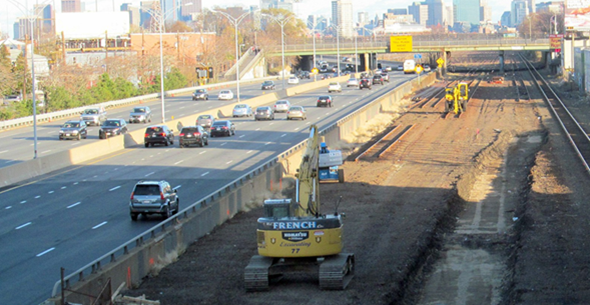
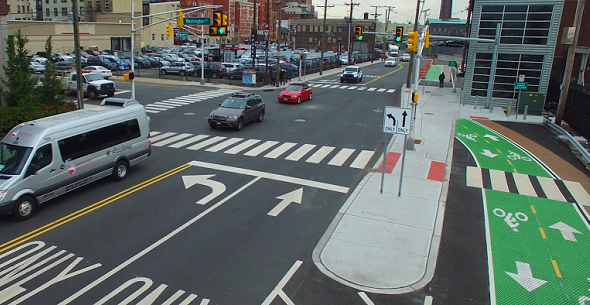
Transportation is the largest source of GHG emissions in the US, accounting for 27% of annual emissions in 2020. GCC works at the nexus of federal-state transportation policy to help inform government initiatives that leverage a broad range of strategies to reduce emissions, including light-duty and heavy-duty vehicle electrification, improved transit, and other lower-carbon, more accessible, and safer transportation options. GCC convenes multi-state and regional policymakers, supports federal and state regulatory policy development, and informs the equitable and effective implementation of state and federal legislation. GCC also supports state and federal efforts to ensure transportation investments benefit communities that have been disproportionately harmed by transportation pollution and underserved by the existing transportation system.
Informing transportation investment decisions
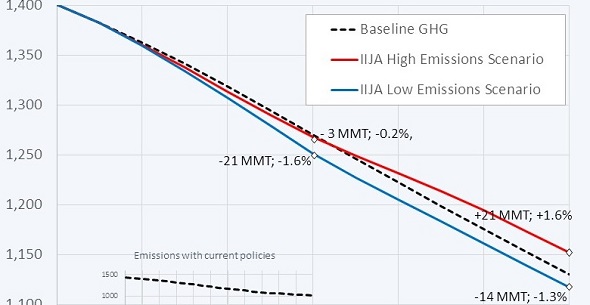
Modeling and Analysis: To inform the national conversation around how best to spend the billions of dollars in federal and state transportation funding, we analyzed the Bipartisan Infrastructure Law using our Transportation Investment Strategy Tool and assessed the potential effects of each of the bill’s surface transportation provisions on emissions outcomes at the national and state levels. We found IIJA could be an important part of the U.S. response to climate change. Or it could lead to more greenhouse gas pollution than the trajectory we are currently on. Where the actual outcome falls within that range will depend on the decisions made by state, federal, and local governments about how to spend the money made available by IIJA.
We partnered with Cambridge Systematics to develop a free online tool – the Transportation Evaluation and Carbon Reduction Tool (TEA-CART) – to help practitioners in state and local departments of transportation quickly assess how investments in their capital plans could affect the future emissions performance of the transportation system.
Legal analysis on flexibility of funding: States have considerable flexibility in how to invest federal transportation funds, and we are providing legal and policy analysis to help state and federal policymakers and stakeholders determine how funds can best be directed toward projects that reduce climate-warming pollution.
Accelerating vehicle electrification
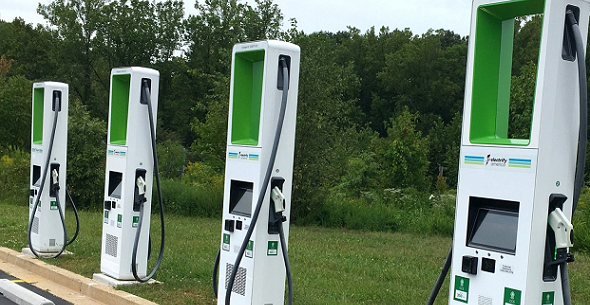
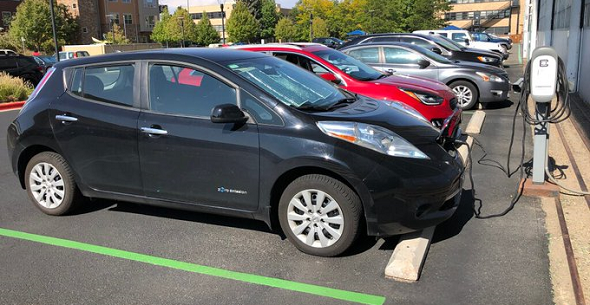
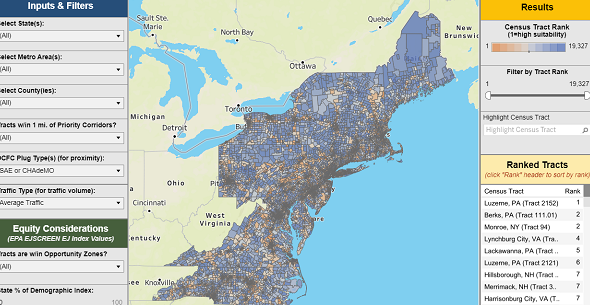
Electric vehicles (EVs) have enormous potential to reduce harmful air pollution and greenhouse gas (GHG) emissions from transportation. GCC has developed legal and policy analysis to inform state and federal investments in EV charging infrastructure, along with mapping and analysis tools to inform discussions between policymakers, local communities, and other stakeholders in considering priority locations for EV fast charging infrastructure investments, including the places most affected by pollution and underserved by existing transportation systems.
Convening states to focus on the GHG performance of federal highways
GCC conducts analysis and convenes states and other stakeholders from across the nation to support the development of federal transportation programs and regulations, with a focus on the performance of the federal highway system. GCC works to inform federal policy with the perspectives and lessons learned from states, including by publishing white papers and policy analyses and facilitating multi-state comment letters.
Expanding community-level air quality monitoring
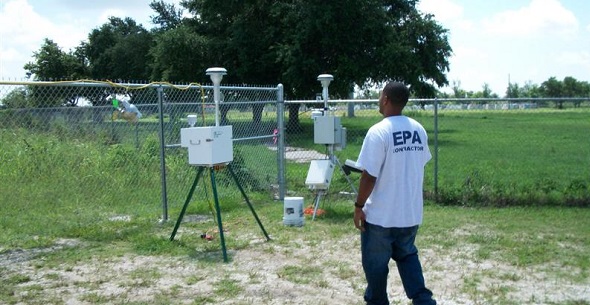
Community and environmental justice advocates have long called for more air quality monitoring in their neighborhoods, and a growing number of political leaders at the federal, state, and local levels of government are now taking responsive actions. To help state agencies respond to community needs, expand community-level air monitoring programs, and achieve the equity and environmental justice goals of their air quality, climate, and clean energy programs, GCC facilitates the Air Quality Monitoring Workgroup (AQMWG). This community of practice among state agency officials in the Northeast and Mid-Atlantic region shares information and best practices regarding community-based air quality monitoring and related policy actions.
Facilitating Northeast and Mid-Atlantic state collaboration
GCC serves as the facilitator and convenor of state transportation, energy, and environment agencies from the Northeast and Mid-Atlantic region working to develop low-carbon transportation policies. This work includes multi-state efforts to consider GHG emissions in transportation investment planning processes, coordinate and support regional electric vehicle (EV) charging infrastructure deployment, build state and local capacity for air quality monitoring, and develop regional low-carbon transportation policies.
Sustainable Communities Indicators Research Paper Series: Promoting Accessibility
June 5, 2014
In support of the Transportation and Climate Initiative’s Sustainable Communities’ work, the Georgetown Climate Center and Rutgers University's Bloustein School of Planning and Public Policy released research papers examining 11 potential indicators that could help measure progress in promoting sustainable communities and demonstrate the benefits of such policies. As one of the papers in that series, this paper examines two indicators—proportion of jobs/housing within X miles of transit and proximity to amenities—and explores approaches that can be used to promote accessibility.
Sustainable Communities Indicators Research Paper Series: Benefits of Investment
June 5, 2014
In support of the Transportation and Climate Initiative’s Sustainable Communities’ work, the Georgetown Climate Center and Rutgers University's Bloustein School of Planning and Public Policy released research papers examining 11 potential indicators that could help measure progress in promoting sustainable communities and demonstrate the benefits of such policies. As one of the papers in that series, this paper provides an overview of the types of economic effects that can result from transportation expenditures, and approaches to quantifying the benefits of such investments.
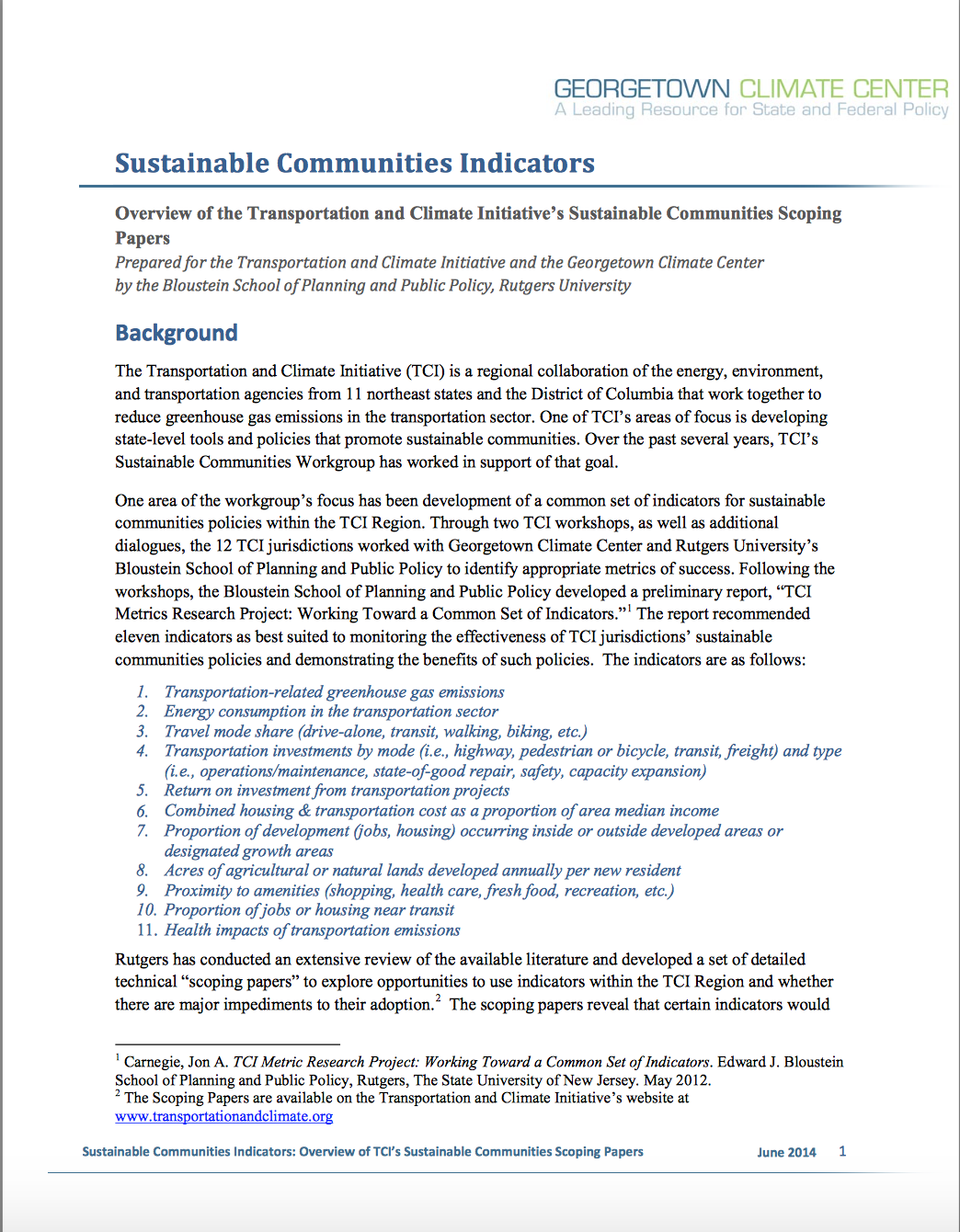
An Overview of the Transportation and Climate Initiative’s Sustainable Communities Scoping Papers
June 5, 2014
In support of the Transportation and Climate Initiative’s Sustainable Communities’ work, the Georgetown Climate Center and Rutgers University's Bloustein School of Planning and Public Policy developed research papers examining 11 potential indicators that could help measure progress in promoting sustainable communities and demonstrate the benefits of such policies. This brief summarizes the findings of the scoping papers, including the indicators that were identified, the potential to use each to evaluate TCI states’ progress on policies and programs, potential strategies each indicator could support, and TCI state programs that already make use of the indicators.
Sustainable Communities Indicators Research Paper Series: Housing and Transportation Costs
June 5, 2014
In support of the Transportation and Climate Initiative’s Sustainable Communities’ work, the Georgetown Climate Center and Rutgers University's Bloustein School of Planning and Public Policy released research papers examining 11 potential indicators that could help measure progress in promoting sustainable communities and demonstrate the benefits of such policies. As one of the papers in that series, this paper explores various approaches for measuring housing and transportation affordability.
Sustainable Communities Indicators Research Paper Series: Land Use Trends
June 5, 2014
In support of the Transportation and Climate Initiative’s Sustainable Communities’ work, the Georgetown Climate Center and Rutgers University's Bloustein School of Planning and Public Policy released research papers examining 11 potential indicators that could help measure progress in promoting sustainable communities and demonstrate the benefits of such policies. As one of the papers in that series, this paper examines two indicators—growth in previously developed/designated acres, and acres of agricultural or natural lands protected—and explores approaches that can be used to track development trends.
Northeast Electric Vehicle Network Partner Pledge
October 11, 2013
Support for electric vehicles in the northeast continues to grow, and states participating in the Northeast Electric Vehicle Network are forging ahead with preparations for the mass market arrival of plug-in cars and trucks and the economic and environmental benefits that these vehicles can deliver.
Menu of Plug-In Electric Vehicle Incentives
January 25, 2013
The Transportation and Climate Initiative (TCI) has compiled this menu of incentives for states to use as a tool when researching ways to reduce barriers and promote electric vehicle use. Most states offer one or more incentives for consumers, businesses, or government entities to purchase and use plug‐in electric vehicles (PEV) or electric vehicle charging stations (also known as electric vehicle supply equipment, or EVSE).
Electric Vehicle Supply Equipment Cluster Analysis
January 25, 2013
In order for public institutions and private sector organizations to work toward an EV-friendly environment, it is important to understand where the greatest opportunities are for enhancing the EVSE network. This report takes a rigorous approach to identifying what types of places make sense for EVSE deployment in order to encourage EV ownership and usage. As both the public and private sectors consider investing in EVSE, infrastructure developers will need to determine how to most efficiently invest limited resources to provide battery charging infrastructure.
Creating EV-Ready Towns and Cities: A Guide to Planning and Policy Tools
December 21, 2012
This report provides guidance to practitioners at all levels of state and local governments wishing to take action to implement EVSE deployment in their jurisdictions. It provides discussion and guidance regarding the steps to create, administer, and amend planning processes, rules, and regulations, and explores the potential for jurisdictions to encourage EV charging station installation and use. Tools to promote EV-friendly zoning regulations, parking ordinances, building codes, permitting practices, and partnership and procurement are explored, and examples of streamlined approaches are provided.
Assessment of Current EVSE and EV Deployment
December 21, 2012
The deployment assessment provides a region-wide look at EV and electric vehicle supply equipment (EVSE) deployment in the Northeast. The report highlights trends in EV ownership and EVSE locations, offers recommendations to maximize the impact of EVSE installations, and offers recommendations for further areas of study.
Image from the NJ Dept. of Transportation Transportation accounts for more than 45 percent of New Jersey’s carbon dioxide emissions, making that sector by far the largest contributor to statewide greenhouse gas...
Fact Sheet: U.S. National Blueprint for Transportation Decarbonization
April 5, 2023
Fact sheet developed by GCC for state officials summarizing the U.S. National Blueprint for Transportation Decarbonization
Issue Brief: States Are in the Driver’s Seat on Transportation Carbon Pollution
March 24, 2023
& By James Bradbury, Zack Subin, Ben Holland, and Ryan Levandowski How states spend federal funding could shift carbon pollution from transportation by as much as 5 percent, making it harder or easier to...
Issue Brief | Flexible Federal Funding Opportunities for State and Local Clean Transportation Investments
February 23, 2023
Executive Summary When it comes to deciding how to spend funds from federal transportation programs, state policymakers — including department of transportation (DOT) officials and state lawmakers — have a...
Issue Brief | States have flexibility to invest federal highway funds in climate-smart transportation
February 21, 2023
The U.S. has seen a historic influx of federal funding for improving America's transportation systems, especially through the $1.2 billion Bipartisan Infrastructure Law (BIL). In a new issue brief, “Flexible Federal...
One Year Later: GCC reflects on the passage of the Bipartisan Infrastructure Law
November 15, 2022
This article was originally posted as a Twitter thread @Climate_Center. Today marks one year since President Biden signed the Bipartisan Infrastructure Law (BIL), also known as the Infrastructure Investment and Jobs Act...
Transportation Agencies from 10 States and D.C. Voice Support for Federal Proposal to Track Greenhouse Gas Emissions from National Highways
October 13, 2022
States Across the Country Say Proposed Performance Measure Can Help Reduce Pollution, Improve Resilience of National Highway System October 13, 2022 — In joint comments submitted to the U.S. Department of...
Driving Resilience: How the bipartisan Infrastructure Investment and Jobs Act can support widespread climate resilience
August 11, 2022
Resilience is integrated throughout sections of the bipartisan Infrastructure Investment and Jobs Act (IIJA) (H.R. 3684, also known as the Bipartisan Infrastructure Law) and includes programs that can help alleviate the...
Statement from the Georgetown Climate Center on FHWA's Proposed GHG Performance Measure
July 7, 2022
This morning, the Federal Highway Administration (FHWA), a division of the U.S. Department of Transportation, released a proposed rule to guide states and metropolitan planning organizations (MPOs) in measuring and...
8 Ways US States and Cities Can Create a National EV Charging Network
June 23, 2022
By: Devashree Saha (Word Resources Institute), Matthew Goetz (GCC), Dan Lashof (World Resources Institute), Franz Litz (Litz Strategies) Electric vehicles (EVs) are on the rise in the United States. The Biden...
- « First Page
- 1
- 2
- 3
- 4
- 5
- 6
- 7
- 8
- Last Page »