

Issue Brief | How Community-Based Air Quality Monitoring Can Make Climate Policy More Equitable
June 1, 2023
By James Bradbury & Emma Cross
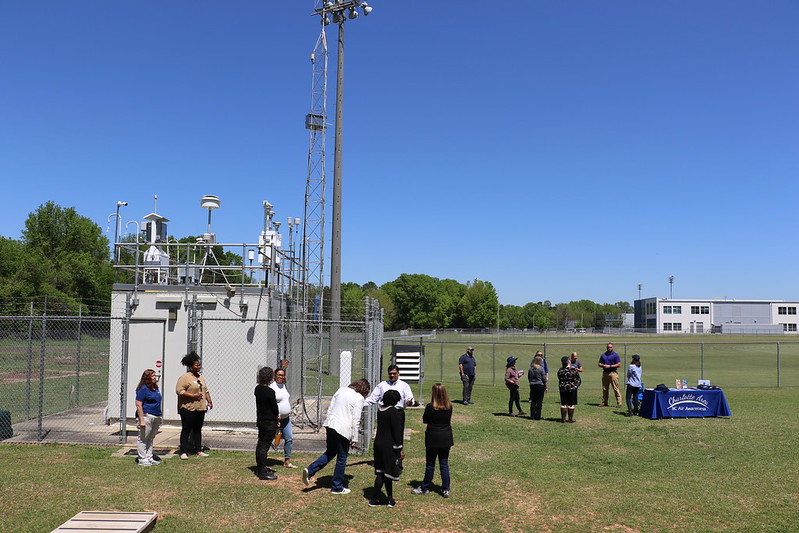 |
| Community tour of an air quality monitoring station. (Image from Mecklenburg County) |
The passage of the federal Inflation Reduction ActSee footnote 1 and the Bipartisan Infrastructure LawSee footnote 2 presents a historic opportunity to reduce the pollution that is warming our planet and putting countless lives and communities at risk from climate change. Furthermore, the implementation of the climate and clean energy programs in these and other laws present many opportunities to directly benefit communities that are overburdened by air pollution.
Air pollution from the burning of fossil fuels causes premature deaths, as well as a wide range of health effects, including reduced lung growth and function in children, heightened risk of respiratory infections, and asthma.See footnote 3 According to the U.S. Environmental Protection Agency (EPA), over 100 million people in the U.S. live in communities where air pollution levels are higher than the EPA’s health-based air quality standards.See footnote 4 We also know that racial and ethnic minorities and lower-income communities in the U.S. face on average 15 percent more exposure to air pollution,See footnote 5 and related health risks than other populations.See footnote 6 These are often referred to as “overburdened communities,” populations that experience multiple and disproportionate environmental, health, and socioeconomic harms and risks.See footnote 7 The urgency of action to reduce emissions, particularly in communities facing these disproportionate burdens, has never been clearer.
But how will the public know whether air quality improvements are happening in the communities that need them the most? How will the public know whether regulators are holding polluters accountable for violations of emissions rules? And which policies and processes are needed to make new investments more transparent and to provide accountability regarding whether justice and equity-related policy goals are being achieved?
While government actions to reduce emissions of greenhouse gases will also result in reductions in other dangerous air pollution, not all communities are guaranteed to realize those benefits, depending on how the policy is designed and implemented. This is why it is important to measure whether policies are improving air quality at the community and neighborhood levels. However, air monitoring at this scale requires comprehensive, sustained efforts, to first establish the current, or baseline conditions, and then to track how pollution changes as a result of new policies.
This Issue Brief discusses how community-based air quality monitoring (CBAQM) can be used to inform climate and energy policy actions as state and local governments are working to expand these activities in partnership with local communities, universities and others. The investment of historic levels of federal funding to support an expansion of community-based monitoring is ushering in a new era of partnerships between community residents, academic researchers, and policymakers across agencies and jurisdictions.
To create such partnerships for the benefit of communities nationwide in ways that meaningfully inform policy and investment decision making, additional capacity – in the form of staffing, funding, and training – is needed within state and local governments – and in many cases within communities and academic institutions. At the federal level, several new programs, such as the Environmental and Climate Justice Block Grant and the Neighborhood Access and Equity Grant Program, authorized by Congress through the Inflation Reduction Act (IRA), were designed to help play this role. The U.S. EPA clearly recognizes the need to build the capacity of communities,See footnote 8 and several federal agencies are making investments in place-based technical assistance through Thriving Communities programs.See footnote 9
Additionally, given the scale of the need and urgency for action, many other new federal programs could be leveraged in ways that better serve the needs of overburdened and underserved communities on an ongoing basis. Toward this end, federal agencies could invite applications for grants to invest not only in local communities, but also in the capacity of state and local governments to establish and maintain local partnerships. Such investments in the capacity of state and local governments are needed to build full-time staff and properly train personnel to sustain a high intake of data and reporting from new projects in ways that ensure these projects can inform regulatory enforcement actions or otherwise contribute to beneficial policy changes.
Background
The federal government and a growing number of statesSee footnote 10 have committed to making sure that overburdened communities receive a significant share of the benefits from infrastructure investments and other programs. The Biden Administration’s Justice40 Initiative, in particular, commits that no less than 40 percent of the benefits of investments made through certain climate and clean energy programs will go to “disadvantaged communities.”See footnote 11
To identify and prioritize benefits for communities where pollution reduction and investments are most needed, policymakers need reliable data about, among other things, the locations where current pollution levels are highest. Furthermore, once new climate programs are in place and infrastructure investments have occurred, the public should be able to track whether those investments are resulting in cleaner air in the places where people live, learn, work, and play. Just as important, government officials and community residents all have to be confident that such data are accurate and reliable. However, the existing air quality monitoring network has been primarily designed to measure specific pollutants or sources for regional air quality, not local air quality, where differences can be stark and the existing network is not sufficient to adequately measure local exposure to all types of air pollution that pose risks to public health.See footnote 12 See footnote 13
The Clean Air Act (CAA) regulates air quality in the United States in part by setting National Ambient Air Quality Standards.See footnote 14 Implementation and enforcement of this law and associated regulations requires states to establish and maintain a network of air quality monitoring stations for regulated pollutants in locations that measure pollutants at an appropriate scale.See footnote 15 Specifically, this requires EPA to measure pollution and generate data that are representative of so-called air quality control regions.See footnote 16 This federal system for ambient air pollution monitoring does not require community-based air monitoring that might identify polluted micro-climates – where communities may be exposed to dangerous levels of air pollution – contributing to an apparent regulatory gap in the CAA.See footnote 17 As a result, while state and local environmental agencies operate and maintain a national network of 3,900 air monitoring devices throughout the country, an estimated 120 million Americans (over one third of the U.S. population), live in counties that have no air pollution monitors to evaluate compliance with the CAA.See footnote 18 Furthermore, in a 2020 report,See footnote 19 the U.S. Government Accountability Office recommended that EPA develop a plan to modernize air quality monitoring, after finding that “the system was unable to meet users' current needs for information to better manage health risks from air pollution.”
Fortunately, a variety of lower-cost air quality sensors (called air sensors) are now commercially available,See footnote 20 and the recent creation of several new federal grant programs creates a historic opportunity to substantially improve and expand local air quality monitoring networks in communities throughout the country. As new monitoring programs are developed and implemented, it is critical to learn from past experiences and make changes that respond to public critiques; for example, from community complaints that data from air monitoring stations may be inadequate or inappropriate to inform government action.See footnote 21
This is why community-government partnerships can be so valuable, to help ensure that new projects are purpose-driven (i.e., designed to inform meaningful pollution-reduction actions). Even well-designed projects face challenges. For one, monitoring technologies do not always work as designed, equipment can be challenging to install, complicated to operate, and resulting data can be difficult to manage and interpret. Furthermore, air quality is dependent on weather, and pollution derives from all kinds of sources – stationary and mobile, natural and human-caused - all of which further complicates efforts to draw meaningful conclusions from monitoring data. The bottom line is that there remains a lot to learn about how best to use air quality monitoring data to inform policy actions that effectively address the challenges and needs of each overburdened community. Working through those challenges in the context of partnerships that are rooted in trust and common understandings of project goals are more likely to lead to positive outcomes.
How community-based air quality monitoring could help to can inform equitable policy actions
To shine a light on environmental injustices and inform new policy actions, advocates have long called for local air quality monitoring in communities overburdened by pollution.See footnote 22 For decades, community-based participatory research projects – such as air monitoring in West HarlemSee footnote 23 – have demonstrated the value of such efforts. Importantly, CBAQM projects can also help to build working relationships between governments and overburdened communities, in part by providing opportunities for community input and by establishing infrastructure – physical and personnel – for greater transparency and accountability around key decision-making processes.
The following are ways that CBAQM can improve transparency, accountability, and meaningful public engagement–all important elements of equitable policy making.
Transparency
- Identifying pollution hotspots: The availability of new ways to monitor air pollution with air sensors at fixed locations and mobile monitors on instrumented-vehicles creates an opportunity for CBAQM to help identify the neighborhoods and communities that are exposed to higher levels of air pollution from transportation and industry. For example, a recent detailed mobile monitoring study conducted in the San Francisco Bay Area confirmed that pollution exposure levels were up to 30 percent higher for Black and Hispanic people than the average for the overall population. Exposures for white populations, by contrast, were up to 14 percent below the average.See footnote 24
- Informing more equitable investments: In the past, investments in energy and transportation infrastructure have better served privileged communities including those with a larger number of white and wealthy residents, leaving other communities underserved or harmed by those investments, and overburdened by air pollution from highways, truck routes, and industrial facilities amongst other high polluting sources.See footnote 25 Identifying air pollution hotspots is one way to inform where future investments are needed to help correct the wrongs of the past.See footnote 26 Furthermore, in response to concerns about identified pollution hotspots as well as other community concerns, some states are being increasingly transparent about how and where clean energy and climate investments are being made. For example, the New Jersey Regional Greenhouse Gas Initiative Climate Investment Dashboard provides information on New Jersey-specific investments in clean energy, clean transportation, and equity programs that utilize proceeds from the Regional Greenhouse Gas Initiative.See footnote 27
Accountability
- Verifying who benefits: To achieve equity-related policy goals, the benefits of climate policies and clean-energy investments need to be real for overburdened communities. Directly measuring air quality at the community level and tracking how it changes due to subsequent policy actions could help assess who is benefiting from new policies and investments.
- Identifying likely pollution sources: Conducting air quality monitoring in communities that are located near industrial facilities, ports, rail yards, and warehouses can create opportunities for neighbors to generate information that helps to identify potential pollution sources. This can help to raise awareness and provide a quantitative basis to advocate for policies that would hold polluters accountable and reduce the harm that they cause to nearby communities.
Meaningful Public Engagement
- Conducting authentic community engagement: For state and local governments, putting more equitable policies and programs into practice must start with authentic community engagement. This involves open and honest, person-to-person dialogues between government officials and residents of overburdened communities.See footnote 28 It requires following processes that are inclusive, accessible, and maintained on an ongoing basis, particularly given the broad range of complex challenges that are facing overburdened communities.See footnote 29
- Investing in capacity building: Establishing and maintaining genuine partnerships can be very resource- and time-intensive, particularly when they involve dedicated personnel capable of installing and maintaining technical equipment, and interpreting and communicating complex information. Effective implementation of CBAQM projects also requires creating public forums – such as technical workshops – where communities and air quality monitoring personnel can work together to interpret results, develop findings and identify solutions. However, state air agencies report lacking adequate funding to carry out the basic responsibilities of their job,See footnote 30 which means they have very limited capacity to implement new or expanded air quality monitoring projects – particularly at the neighborhood-level or at a scale and pace to fully match the need. For residents of overburdened communities, resources, and capacity may also be limited for community-engaged research and prioritized in favor of other community needs.
- Building trust through long-term engagement: Working with community residents to design purpose-driven CBAQM projects takes robust, sustained commitments to meaningful public engagement on the part of government agencies and – for cooperative research projects – in the communities that those agencies represent. If well designed and implemented with meaningful community involvement, genuine research partnerships can also serve as foundations for more equitable policy making, investment decision making, and timely enforcement actions against polluters. Long-term investments of resources are necessary to establish genuine partnerships and build the trust needed to cooperatively identify and implement policy solutions that address community needs. Furthermore, in cases where results from policies or air monitoring projects are different from what a community expects, the trust formed through genuine partnerships can be invaluable for navigating “next steps” that are appropriate and mutually acceptable.
Examples of Community-Based Air Quality Monitoring in Practice
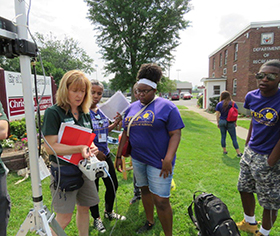 |
| Air quality screening with University of Albany STEP in the City of Albany. |
As noted above, communities in West Harlem and elsewhere have been conducting CBAQM for years. Beginning in the 1990s, a research partnership between WE ACT for Environmental Justice and the Columbia Children’s Center for Environmental Health (CCCEH) influenced policy outcomes for New Yorkers.See footnote 31 This effort contributed to the New York Metropolitan Transit Authority’s decision to replace their bus fleet with lower-emitting vehicles, starting in 2000, plus the addition of new air quality monitors in high-risk locations in New York City and other urban areas around the country measuring pollutants such as black carbon, nitrogen oxide, and nitrogen dioxide.See footnote 32 Years later, the decision to switch to cleaner buses in New York and other cities around the country resulted in declines in air pollution.See footnote 33 Since then, the New York Department of Environmental Conservation (NY DEC) has increased its community-based air quality monitoring work – in South Albany, for example monitoring pollutants such as benzene, black carbon, nitrogen oxides, and particulate matter.See footnote 34 Most recently, NY DEC launched a multi-million dollar statewide community air quality monitoring effort.See footnote 35
Recent experiences in California also offer learning opportunities. For example, following the passage of Assembly Bill (AB) 617, in 2017, the California Air Resources Board (CARB) established the Community Air Protection Program, which directly supports community efforts to measure air pollution and to use those data to inform policy actions. Descriptions of community projects funded by AB 617 are available on the program’s website.See footnote 36
To help facilitate implementation at the local level, the Bay Area Air Quality Management District in the San Francisco area also provides technical support through, for example, The Bay Air Center,See footnote 37 which serves as a third-party organization that responds directly to community requests for technical support to help advance local air monitoring and related education and policy. The Bay Air Center does this by providing technical services to communities to help them establish monitoring projects and other strategies, such as modeling and data interpretation, in ways that enable communities to more effectively advocate for air quality improvements in their communities. Similarly, as noted above, federal agencies are implementing Thriving Communities programs to help support local and regional implementation of federal programs.
To help state agencies be more responsive to increased demand for local air monitoring by community-based organizations, the Georgetown Climate Center is helping to facilitate a community of practice among state agency officials in the Northeast and Mid-Atlantic states.See footnote 38 The purpose of creating this community of practice -- known as the Air Quality Monitoring Workgroup (Workgroup) -- is to share information and best practices regarding CBAQM and related policy actions to help achieve the justice goals of improved air quality, climate mitigation, and clean energy programs that reach overburdened communities. The Workgroup receives substantive and facilitation support from veteran environmental justice leader Vernice Miller-Travis, at the Metropolitan Group,See footnote 39 and experienced air quality monitoring practitioner Tim Dye, at TD Environmental Services.See footnote 40
Members of this Workgroup are collaborating with university researchers and other organizations (including local and state public health agencies, and environmental advocates), in partnership with communities, to conduct local air quality monitoring within their jurisdictions. For example, in New Jersey, the Department of Environmental Protection is partnering with Rutgers University and Newark Public Schools to educate and assist students in performing local air sampling to produce data that will be presented to the state agency.See footnote 41 In Maryland, the Department of Environment is partnering with the University of Maryland’s Community Engagement, Environmental Justice, and Health Laboratory and the Town of Cheverly to implement a local air monitoring program in the Cheverly area using low-cost sensors to look at community-scale air quality.See footnote 42 As noted above, in New York, the Department of Environmental Conservation is working in partnership with community-based organizations to map hyperlocal air pollution and greenhouse gasses through a mobile monitoring initiative in 10 disadvantaged communities.See footnote 43
Key Policies and Programs to Watch
New Federal Funding Presents New Opportunities
The good news is that the recently enacted Inflation Reduction Act (IRA) and other new federal legislation make available game-changing resources for CBAQM and other community-driven solutions to climate change. In November 2022, 132 projects throughout 37 states received a total of $53.4 million in grants from EPA specifically for community air quality monitoring.See footnote 44 Selected projects involve partnerships among a wide range of organizations that will collaborate on installing sensors, creating air quality measurement networks, and increasing awareness in communities. The recipients include individual state agencies such as the Rhode Island Department of Health; municipalities such as the City of Stamford, CT; and community organizations that work across multiple states, like Appalachian Voices, which operates out of North Carolina.See footnote 45 Furthermore, to help address the limited capacity of community-based organizations and smaller municipalities to successfully apply for federal grants and maintain the necessary paperwork for reporting purposes, the U.S. EPA, in partnership with the U.S Department of Energy recently awarded $177 million to 17 Environmental Justice Thriving Communities Technical Assistance Centers (EJ TCTACs). However, even with the new federal funding, sustained efforts will be needed to build and maintain partnerships to ensure that the benefits of federal investments reach overburdened communities.
As a result of the unprecedented scale of new federal funding for air quality monitoring,See footnote 46 coupled with commitments by political leaders to improve conditions for “environmental justice communities” (described below), overburdened communities – and the public, at large – could soon have a much better understanding of how pollution is affecting them. This moment also presents a critical opportunity to establish partnerships and build capacities that could lead to real and lasting policy solutions.
Federal and State Commitments to Equity and Justice
The Biden Administration’s Justice40 Initiative commits that no less than 40 percent of the benefits of investments made through certain climate and clean energy programs will go to “disadvantaged communities.”See footnote 47 This approach mirrors state-led approaches first introduced in CaliforniaSee footnote 48 and New YorkSee footnote 49 that require at least 35 to 40 percent of certain climate and clean energy program investments to occur in – or for the benefit of – overburdened and underserved communities. To live up to these goals, it is critical for the public to understand where pollution levels are higher, where investments are needed, and whether strategies have been effective in addressing pollution hotspots.
Successful implementation of Justice40 and similar state policies requires a new approach to policy making and implementation, beginning with collaborative work and meaningful engagement at the community level. Important details of how Justice40 will be implemented have emerged over the past year, including exactly which federal climate and clean energy programs fall under the Justice40 InitiativeSee footnote 50 and how “disadvantaged communities” will be defined. To define communities that are more burdened by air pollution, in November 2022 the White House released Version 1.0 of the Climate and Economic Justice Screening Tool (Tool),See footnote 51 which was updated following public input on a draft version published in early 2022. To help identify disadvantaged communities, the Tool uses two indicators of particulate matter (PM2.5) concentrations in the air, drawing from historical data in EPA’s EJScreen tool.See footnote 52 As important and valuable as these indicators are, EJScreen documentationSee footnote 53 describes some of the inherent limitations of available air quality data and how modeling is used to address gaps in the monitoring data. Some of these limitations include difficulty representing small geographic areas and not being able to measure every air pollutant that poses a risk to public health.See footnote 54
Recognizing that the data underlying the above-mentioned screening tools are imperfect and incomplete (e.g., many harmful air pollutants are not included in the Tool), there is a role for local air quality monitoring to help inform state and local approaches to implementation of justice and equity policies and initiatives. Community-based air quality data may also be useful to inform future versions of the Tool and other similar screening tools.See footnote 55
New Federal Funding Opportunities
The unprecedented levels of funding available through new federal programs create historic opportunities to expand the use of CBAQM in ways that inform new policies and investments in environmental justice communities that are overburdened by air pollution. Importantly, most funding in the IRA is authorized for 10 years and federal agencies are already working to implement new programs in ways that are mindful of community needs, for example, through Thriving Communities programs in several agencies, including the U.S. Department of Transportation,See footnote 56 Housing and Urban Development,See footnote 57 and the EPA.See footnote 58 These programs will provide technical assistance, training, and other support to EJ communities and partners interested in applying for federal funding.
As noted above, the first major round of grant funding for air quality monitoring was awarded by EPA in late 2022 through the Enhanced Air Quality Monitoring Funding program.See footnote 59 This program was first set up following the passage of the American Rescue PlanSee footnote 60 and, as described above, competitive grant awards are providing funding for dozens of local air quality monitoring projects in underserved and overburdened communities throughout the country. This program presents many opportunities, but also challenges for state agenciesSee footnote 61 to ensure that the data from these new projects – which air agency officials may or may not be directly involved with – are collected, processed, and interpreted in ways that meaningfully address community needs.
In particular, the IRA,See footnote 62 includes several funding opportunities for CBAQM projects, in both direct and indirect ways.
Directly, the IRA provides over $200 million over 10 years for new EPA grant programs that are specifically designed to support air quality monitoring, identify pollution hotspots and address pollution at schools (Sec. 60105 and 60106). This number grows to over $6 billion over 10 years if you also account for IRA programs in which air quality monitoring is listed as an eligible activity. This includes competitive grant programs that can support air quality monitoring in overburdened communities and capacity building through community-based programs (Sec. 60201 and sec. 60501).
For community-serving organizations and Tribal governments that seek to engage in air quality monitoring, the following federal programs will provide critical resources:
Funding to Address Air Pollution, through EPA ($170.5M)
- Section 60105 includes over $170.5 million to deploy, integrate, support, and maintain air monitoring, national air toxics trend stations, and other air toxics and community monitoring stations. Included in this program is dedicated funding for fenceline monitoring, expanding the National Ambient Air Quality Standards (NAAQS) monitoring network, and deploying air quality sensors in low-income communities. Over $30 million of these dollars were recently granted already through the Enhanced Air Quality Monitoring Funding program.
Funding to Address Air Pollution at Schools, through EPA ($50M)
- Section 60106 appropriates $50 million for grants to monitor and reduce greenhouse gas emissions and other air pollutants at schools in low-income and disadvantaged communities. Included in this fund is money to provide technical assistance to address environmental issues or identifying and mitigating air pollution hazards at these schools. This money is granted to air pollution control agencies as defined by the Clean Air Act §7405(a).
Environmental and Climate Justice Block Grants, through EPA ($3B)
- Section 60201 provides $3 billion for various three-year grants and technical assistance for projects involving community-led air and other pollution monitoring and prevention, workforce development, reducing greenhouse gas emissions, and addressing other climate change-related issues. Entities eligible for these grants include community-based nonprofits, partnerships between community-based groups, Tribal governments and indigenous community-based groups, local governments, or institutions of higher education.
The Neighborhood Access and Equity Grant Program, through FHWA ($3B)
- Section 60501 provides $3 billion to the Federal Highway Administration for competitive grants to improve affordable transportation access, reduce the harms caused by transportation infrastructure to disadvantaged or underserved communities, and for planning and capacity building activities in disadvantaged or underserved communities. Grants for planning and capacity building can include projects that monitor and assess local air quality to identify pollution and extreme heat hot spots. Entities eligible for these grants include states, cities, territories, transportation-related public authorities, and metropolitan planning organizations.
Indirectly, the IRA also includes tens of billions of additional dollars for new grant programs designed to fund investments to improve air quality or cut greenhouse gas emissions. These programs could likely also fund related air quality monitoring and capacity building, since monitoring is an important step in identifying pollution sources and air quality problem areas.See footnote 63
EPA and other agencies are taking important steps to implement these programs in ways that will help ensure that they center equity and environmental justice.See footnote 64 This presents a historic opportunity to invest in capacity building for communities and agencies working to advance the equity and justice aspects of climate, energy, and transportation policies.
Climate Pollution Reduction Grant Program, through EPA ($5B)
- Sec. 60114 establishes a new EPA program that provides $250 million for noncompetitive planning grants, and $4.6 billion for competitive implementation grants. The program guidance that EPA released on March 1, 2023, suggests that data from emissions monitoring could be used to inform status reports regarding grant deliverables. This may present an opportunity for implementation grant funding to help build the capacity of government agencies to support air monitoring activities that better identify overburdened communities and, over time, measure the effectiveness of emission-reduction strategies. Eligible entities for these grants include states, air pollution control agencies, municipalities, and Tribal governments.
Grants to Reduce Air Pollution at Ports, through EPA ($3B)
- Section 60102 provides $2.25 billion in assistance to purchase or install zero-emission port equipment or technology to serve ports with an additional $750M to ports in nonattainment areas. This grant can also be used to conduct any relevant planning or permitting in connection with the purchase or installation of such zero-emission port equipment or technology.See footnote 65 Air quality monitoring could help to identify which ports are most urgently in need of the zero-emission technology, or to help identify which sources are responsible for the most harmful pollutants. Eligible recipients of this grant include port authorities, state, regional, local, Tribal agencies, and/ or private entities working in partnership with ports.
Greenhouse Gas Reduction Fund (GGRF), through EPA ($27B)
- Section 60103 provides $27 billion in grant, loan, and other financial assistance to help deploy zero-emission technologies. On April 19, 2023, EPA released an implementation framework for the GGRF, which is designed to leverage public investment to finance clean energy projects that reduce pollution and energy costs, increase energy security, create jobs, build capacity of community lenders, and deploy cost-saving solar power projects. The framework aims to prioritize delivering benefits to “low-income and disadvantaged communities,” consistent with the Biden Administration’s Justice40 Initiative. Eligible recipients of funding could include states, municipalities, Tribal governments, and certain nonprofits.
What’s Next?
The $53 million in funding that EPA announced in late 2022 for Enhanced Air Quality Monitoring in communities is a down payment that can be built upon with new programs created through the IRA. The new monitoring projects that just received EPA grant awards – advanced in collaborations between government officials, communities, and academic researchers – could yield valuable lessons, plus policy-relevant data and information. This will help to inform decision making, including where investments are needed, how to reduce local pollution, and whether policies are achieving expected results. But much more is needed.
To achieve the life-saving policy goals that federal, state, and local governments have set for themselves, environment, energy, transportation, and public health agency officials will need to act more quickly and creatively to incorporate new and expanded CBAQM efforts into a wide range of climate and clean energy programs. Doing so on an ongoing basis would help to build the capacity of state and local governments, and university partners, to more effectively help their overburdened communities, who are most in need of support and policy action.
In particular, federal agencies could develop program guidance for new IRA programs that provide tools and other resources to help state and local governments make use of new and existing community-based air quality monitoring data to inform policy actions that will result in improved air quality. Furthermore, EPA could expand the number of programs through which state and local governments may invest in CBAQM projects and activities. For example, the Grants to Reduce Air Pollution at Ports and the Climate Pollution Reduction programs could potentially yield better outcomes for overburdened communities if their implementation is informed by related air pollution monitoring.See footnote 66 Further, it is unclear to what extent this first round of grants reached and directly engaged “disadvantaged communities'' and overburdened community residents. Going forward, agencies may need to take additional steps to ensure that program funding achieves the goals of the Justice40 initiative, by directly reaching the most overburdened communities, and fostering policy changes necessary to eliminate public health risks and improve air quality.
Meanwhile, state and local agencies will need to add more staff capacity to conduct meaningful public engagement and expand air quality monitoring in overburdened communities.See footnote 67 This will be much easier to do to the extent that federal grant programs provide funding to support these staff positions and activities. Communities also need financial support to actively engage in and shape the policy making and implementation processes, provide direction and guidance to state and local agencies, participate in interpreting air monitoring results, and directly take advantage of the many new federal and state funding opportunities for investment in their neighborhoods. Federal agencies are taking important steps in this direction,See footnote 68 but further support from Congress and state legislatures will be needed to sustain these efforts on an ongoing basis.
Expanding air quality monitoring in overburdened communities is a crucial element to building more transparency and accountability into policy making processes. Air monitoring on its own will not guarantee more equitable outcomes, but community and environmental justice advocates have long called for more air quality monitoring in their neighborhoods and a growing number of political leaders at the federal state and local levels of government are now taking responsive actions. By conducting meaningful public engagement and working collaboratively on air quality monitoring programs with overburdened communities, state and local governments can lay the groundwork for climate and transportation policies that are able to deliver on their justice-related promises.
Special thanks to the external reviewers, who generously provided valuable feedback on this Issue Brief: Staci Rubin, former Vice President, Environmental Justice, Conservation Law Foundation, Deidre Sanders, Ph.D, Founder and Principal, ArkSpring Consulting, and Barbara Morin, Environmental Analyst, NESCAUM. Additionally, the authors are grateful to Rob Sassor, from the Metropolitan Group, and Tim Dye, at TD Environmental Services, who provided very insightful comments on earlier versions of this Issue Brief.
Endnotes:
2
2. Also known as the Infrastructure investment and Jobs Act (IIJA); View Source | Back to contentBack to content
3
3. World Health Organization, “New WHO Global Air Quality Guidelines aim to save millions of lives from air pollution” (Sept. 22, 2021) Back to contentBack to content
4
4. Environmental Protection agency, “Air Quality - National Summary” (last updated June 1, 2022) View Source. | Back to contentBack to content
5
5. White people are exposed to lower than average concentrations from emission source types causing 60 percent of overall exposure, whereas people of color experience greater than average exposures from source types causing 75 percent of overall exposure. View Source | Back to contentBack to content
6
6. Harvard T.H. Chan School of Public Health, “Racial, ethnic minorities and low-income groups in U.S. exposed to higher levels of air pollution” (January 12, 2022) View Source. | Back to contentBack to content
7
7. U.S. EPA defines "overburdened communities" as: “Minority, low-income, tribal, or indigenous populations or geographic locations in the United States that potentially experience disproportionate environmental harms and risks. This disproportionality can be as a result of greater vulnerability to environmental hazards, lack of opportunity for public participation, or other factors. Increased vulnerability may be attributable to an accumulation of negative or lack of positive environmental, health, economic, or social conditions within these populations or places. The term describes situations where multiple factors, including both environmental and socio-economic stressors, may act cumulatively to affect health and the environment and contribute to persistent environmental health disparities.” Environmental Protection Agency, “EJ 2020 Glossary, (last updated August 18, 2022) View Source. | Back to contentBack to content
8
8. U.S. Environmental Protection Agency, “Growing Grassroots: Building Capacity for Environmental Justice Work”, (last updated Jan 25, 2023) View Source. | Back to contentBack to content
9
9. U.S. Department of Transportation. “Federal Interagency Thriving Communities Network,” (last updated January 3, 2023) View Source. | Back to contentBack to content
10
10. See e.g., New York Climate Act requires NY to invest or direct resources to ensure that disadvantaged communities receive at least 35 percent, with the goal of 40 percent, of overall benefits of spending on clean energy and energy efficiency programs. View Source; Washington State’s Climate Commitment Act requires at least 35% of funds be invested in projects that benefit overburdened communities, and a minimum of 10% go to projects with tribal support. View Source | Back to contentBack to content
11
11. “Disadvantaged communities” are defined slightly differently from “overburdened communities” and are based on parameters described in the Climate and Economic Justice Screening Tool. The White House, “Biden-Harris Administration Launches Version 1.0 of Climate and Economic Justice Screening Tool, Key Step in Implementing President Biden’s Justice40 Initiative” (November 22, 2022) View Source. | Back to contentBack to content
12
12. U.S. Gov’t Accountability Off., GAO-22-106136, Air Quality Information: Need Remains for Plan to Modernize Air Monitoring (2022) View Source. | Back to contentBack to content
13
13. Vijay Limaye, John Walke & Emily Davis. "Local Air Quality Monitoring Lagging Across U.S., NRDC Finds." NRDC Expert Blog (2023). View Source | Back to contentBack to content
14
14. Environmental Protection Agency, “Reviewing National Ambient Air Quality Standards (NAAQS): Scientific and Technical Information” (last updated July 28, 2022) View Source. | Back to contentBack to content
15
15. Designation of Air Quality Control Regions, 40 C.F.R. § 81.11. Back to contentBack to content
16
16. Network Design Criteria for Ambient Air Quality Monitoring. 40 C.F.R. § 58. Back to contentBack to content
17
17. Anne Carlson, The Clean Air Act’s Blind Spot: Microclimates and Hotspot Pollution, 65 UCLA LAW REV. 1036, 1046 (2018). Back to contentBack to content
18
18. David Coursen, Environmental Justice Requires Adequate Air Quality Monitoring System, Bloomberg Law, March 9, 2021, View Source. | Back to contentBack to content
19
19. U.S. Gov’t Accountability Off., GAO-22-106136, Air Quality Information: Need Remains for Plan to Modernize Air Monitoring (2022) View Source. | Back to contentBack to content
20
20. Environmental Protection Agency, “Low-Cost Air Quality Sensors Webinar Archive” (last updated April 20, 2022) View Source. | Back to contentBack to content
21
21. WE ACT, “WE ACT for Environmental Justice Provides Testimony at U.S. Senate’s Environment and Public Works Committee Hearing on Proposed Air Quality Monitoring Legislation” (July 13, 2022) View Source. | Back to contentBack to content
22
22. See e.g. Environmental Justice Leadership Forum on Climate Change “Environmental Justice State Guidance For Clean Power Planning” (January 2016) View Source; Massachusetts Department of Environmental Protection, “Massachusetts 2022 Air Monitoring Network Plan Response to Comments” (October 27, 2022) View Source; Environmental Protection Agency, “White House Environmental Justice Advisory Council Final Recommendations: Justice40, Climate and Economic Justice Screening Tool and Executive Order 12898 Revisions” (last updated July 7, 2022) View Source. | Back to contentBack to content
23
23. Meredith Minkler, Victoria Breckwich Vásquez, and Peggy Shepard, “Promoting Environmental Health Policy Through Community Based Participatory Research: A Case Study from Harlem, New York” J Urban Health (January 2006) View Source. | Back to contentBack to content
24
24. Aclima, “New Research Shows Racial and Ethnic Disparities in Hyperlocal Air Pollution” (September 9, 2021) View Source. | Back to contentBack to content
25
25. See: Deborah N. Archer, "White Men's Roads Through Black Men's Homes": Advancing Racial Equity Through Highway Reconstruction, 73 Vand. L. Rev. 1259 (2020), View Source; Proposed National Emission Standards for Hazardous Air Pollutants: Gasoline Distribution Technology Review and Standards of Performance for Bulk Gasoline Terminals Review, 87 Fed. Reg. 35637-35638 (June 10, 2022); B. Diana, M. Ash, J.K. Boyce, Green for All: Integrating Air Quality and Environmental Justice into the Clean Energy Transition, University of Massachusetts Political Economy Research Institute, page 14. | Back to contentBack to content
26
26. Since it is not possible to monitor all the time at every location, emissions modeling is a very valuable tool for accurately characterizing air quality and pollution exposure for populations, e.g., EPA’s AirToxScreen. Back to contentBack to content
27
27. New Jersey RGGI Climate Investments, View Source. | Back to contentBack to content
28
28. National Environmental Justice Advisory Council, “Model Guidelines for Public Participation” (January 25, 2013) View Source. | Back to contentBack to content
29
29. “(Re)investing in Community: How Environmental Justice Communities & Tools are Reshaping Climate and Energy Investments.” Arianna Zrzavy, ILLUME (March 17, 2022). View Source. | Back to contentBack to content
30
30. National Association of Clean Air Agencies, Testimony Regarding the FY 2024 Budget for the U.S. Environmental Protection Agency (Mar. 16, 2023), View Source | Back to contentBack to content
31
31. Meredith Minkler, Victoria Breckwich Vásquez, and Peggy Shepard, “Promoting Environmental Health Policy Through Community Based Participatory Research: A Case Study from Harlem, New York” J Urban Health (January 12, 2006) View Source. | Back to contentBack to content
32
32. Columbia University Mailman School of Public Health, “New York City Switch to Clean Buses Cut Air Pollution” (August 3, 2022) View Source. | Back to contentBack to content
33
33. Columbia University Mailman School of Public Health, “New York City Switch to Clean Buses Cut Air Pollution” (August 3, 2022) View Source. | Back to contentBack to content
34
34. Albany South End Neighborhood Air Quality Initiative. View Source | Back to contentBack to content
35
35. 2022-23 Statewide Community Air Monitoring Initiative. View Source | Back to contentBack to content
36
36. California Air Resource Board, “Community Air Protection Program Communities” (last updated May 13, 2022) View Source. | Back to contentBack to content
37
37. Bay Air Center, View Source. | Back to contentBack to content
39
39. Metropolitan Group, View Source. | Back to contentBack to content
40
40. TD Environmental Services, www.TDEnviro.com Back to contentBack to content
41
41. New Jersey Department of Environmental Protection “Status Report: NJDEP Community Air Monitoring Projects” (March 10, 2014). View Source. | Back to contentBack to content
42
42. Maryland Department of Environment, “Cheverly Targeted Inspection Initiative” View Source. | Back to contentBack to content
43
43. “Governor Hochul Announces Launch of First Statewide Mobile Air Monitoring Initiative” July 6, 2022 View Source. | Back to contentBack to content
44
44. Environmental Protection Agency, “Selections for the ARP Enhanced Air Quality Monitoring Competitive Grant” (last updated November 8, 2022) View Source. | Back to contentBack to content
45
45. Environmental Protection Agency, “Selections for the ARP Enhanced Air Quality Monitoring Competitive Grant” (last updated November 8, 2022) View Source. | Back to contentBack to content
46
46. Inflation Reduction Act, H.R. 5376, 117th Congress (2022) View Source. | Back to contentBack to content
47
47. The White House, “Justice40” View Source. | Back to contentBack to content
48
48. California Global Warming Solutions Act of 2006 (Assembly Bill 32, Nunez, 2016) View Source. | Back to contentBack to content
49
49. New York Climate Leadership and Community Protection Act, S6599 View Source. | Back to contentBack to content
50
50. The White House, “Justice40 Initiative” View Source. | Back to contentBack to content
51
51. The White House, “Biden-Harris Administration Launches Version 1.0 of Climate and Economic Justice Screening Tool, Key Step in Implementing President Biden’s Justice40 Initiative” (November 22, 2022) View Source. | Back to contentBack to content
52
52. Council on Environmental Quality, Methodology and Data: View Source. | Back to contentBack to content
53
53. Environmental Protection Agency, “EJSCREEN, Environmental Justice Mapping and Screening Tool, Technical Documentation” (September 2019) View Source. | Back to contentBack to content
54
54. Environmental Protection Agency, “Limitations and Caveats in Using EJScreen” (last updated Jan 30, 2023) View Source. | Back to contentBack to content
55
55. In addition to expanding air quality monitoring studies in overburdened communities, modeling will also continue to yield important information about pollutants, sources and risks associated with exposure. Increasingly, other technologies like satellite imagery and infrared cameras can help to characterize emissions. Therefore, it is important that community monitoring studies be designed to take into account all available information and that the results are used in conjunction with information from other sources. Back to contentBack to content
56
56. Department of Transportation, “Thriving Communities Program” (last updated Dec. 12, 2022) View Source. | Back to contentBack to content
57
57. Department of Housing and Urban Development, “Thriving Communities Technical Assistance” (last updated Mar. 13, 2023) View Source. | Back to contentBack to content
58
58. Environmental Protection Agency, “The Environmental Justice Thriving Communities Technical Assistance Centers Program” (last updated Feb. 9, 2023) View Source. | Back to contentBack to content
59
59. Environmental Protection Agency, “Enhanced Air Quality Monitoring Funding under the ARP” (November 8, 2022) View Source. | Back to contentBack to content
61
61. Georgetown Climate Center, “GCC comments to US EPA: Inflation Reduction Act offers opportunity to expand and improve air quality monitoring for overburdened communities” (Jan. 26, 2023) View Source. | Back to contentBack to content
62
62. Inflation Reduction Act, H.R. 5376, 117th Congress (2022) View Source. | Back to contentBack to content
63
63. This is not a complete list; there are many more climate and clean energy programs that the Biden Administration has committed to cover under the Justice40 Initiative; federal, state, and local agencies could choose to implement a wide variety of programs and policies in ways that are informed by data collected through new and expanded air quality monitoring programs. Back to contentBack to content
64
64. Environmental Protection Agency,” Advancing Environmental Justice”, (last updated March 7, 2023) View Source. | Back to contentBack to content
65
65. On May 8, EPA issued a related Request for Information, which is open through June 5: View Source | Back to contentBack to content
66
66. Find additional suggestions for EPA here: Georgetown Climate Center, “GCC comments to US EPA: Inflation Reduction Act offers opportunity to expand and improve air quality monitoring for overburdened communities” (Jan. 26, 2023) View Source. | Back to contentBack to content
67
67. National Association of Clean Air Agencies, Draft Testimony Regarding the FY 2024 Budget for the U.S. Env’t Prot. Agency (Mar. 2, 2023), View Source. | Back to contentBack to content
68
68. For example: EPA recently posted a request for applications to the 2023 Environmental Justice Thriving Communities Grantmaking (EJ TCGM) Program, which will make $550 million available to 11 eligible entities that will, in turn, provide assistance to communities and “reduce barriers to the application process and increase the efficiency of the awards process for environmental justice grants.” Back to contentBack to content