

Blog | Leading By Example: Federal Agencies Update their Adaptation Plans
July 31, 2024 | by Joshua Saks
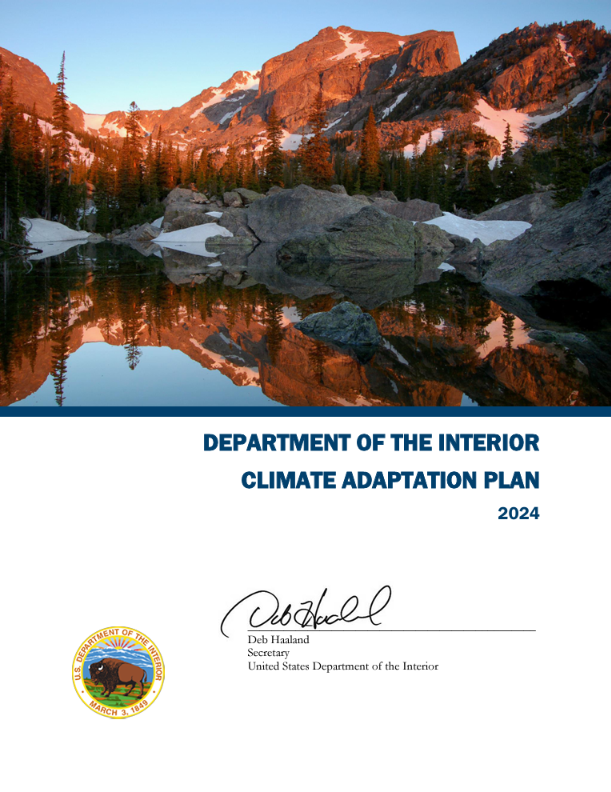 On June 20, 2024, The Biden-Harris Administration announced the release of updated Climate Adaptation Plans developed by 28 federal agencies and departments. The plans “expand agency efforts to ensure their facilities, employees, resources and operations are increasingly resilient to climate change impacts.”
Plans were updated and revised in coordination with the White House Council on Environmental Quality (CEQ) and the Office of Management and Budget (OMB). This is the first revision of the plans (they were originally published in 2021) and details plans for the years 2024 through 2027.
GCC reviewed plans from the Department of Agriculture (USDA) Environmental Protection Agency (EPA), Department of the Interior (DOI), Department of Homeland Security (DHS), and the Army Corps of Engineers (USACE). All 2024 plans are available here: Federal Progress, Plans, and Performance | Office of the Federal Chief Sustainability Officer
GCC noted three key aspects of these plans, discussed in more detail below. These are: (1) There has been considerable progress made by the Federal Government as it undertakes comprehensive risk analysis and climate adaptation planning, (2) Even at a steady pace, adaptation planning takes time and analysis, time that communities don’t have as they deal with the effects of a warming world, and (3) Risk assessments are critical and require spatial analysis and climate and future conditions forecasting, something the federal adaptation plans do quite well.
Federal Agencies are Leading by Example and Making Real Progress
We can think of climate adaptation planning -- whether it’s for a federal agency, a state, a tribe, or a municipality -- as having three main phases. Phase 1 is risk assessment: identifying the specific climate driven changes that could affect the people and operations of the jurisdiction in question. A good risk assessment is the foundation on which the other two phases -- Phase 2: Risk-Mitigation Planning and Phase 3: Implementation -- are built.
Unsurprisingly, the first iteration of agency-specific climate adaptation plans, released in fall 2021 as Climate Action or Climate Adaptation Action Plans, were high-level, notional risk-assessments and related actions. Each agency focused on a unique set of agency specific or unique “vulnerabilities” and “actions.”
- For example in 2021, DOI identified agency vulnerabilities as (1) People, communities and cultural resources, (2) Healthy Watersheds and Water Supplies, (3) Biodiversity and Ecosystems, (4) Coastal and Marine Resources and (5) Infrastructure and Facilities.
- EPA identified its vulnerabilities as: (1) Air quality (2) Water quality (3) Contaminated sites(4) Chemical safety and pollution prevention, and (5) EPA’s facilities and operations.
The vulnerabilities identified in the 2024 plan updates are much more focused, with all agencies focusing on the impacts to facilities, operations, staff, and mission to a lesser degree. Similarly, the actions detailed in the 2024 plans are more focused and streamlined compared to the 2021 recommendations.
- In 2021, DOI recommended actions to: (1) promote climate-resilient lands, waters and cultural resource, (2) Advance climate equity, (3) Transition to a resilient clean energy economy, (4) Support tribal and insular community resilience, and(5) Empower the next generation of conservation and resilience workers.
- EPA meanwhile detailed the following actions: (1) Integrate climate adaptation into EPA programs, policies, rulemaking processes, and enforcement activities. (2) Consult and partner with states, tribes, territories, local governments, environmental justice organizations, community groups, businesses, and other federal agencies to strengthen adaptive capacity and increase the resilience of the nation, with a particular focus on advancing environmental justice, (3) Implement measures to protect the agency’s workforce, facilities, critical infrastructure, supply chains, and procurement processes from the risks posed by climate change, (4) Measure and evaluate performance, (5) Identify and address climate adaptation science needs.
The actions in the 2024 plans, like the vulnerabilities, are streamlined, harmonized, and all agencies are working towards the same goals: to protect workers, to mitigate flooding, heat and extreme weather risks to building, to address supply chain issues and ultimately to understand how climate change will impact, change or complicate an agency’s particular mission.
The revised versions released last month show tremendous progress and growth. Participating agencies are moving from Phase 1 to Phase 2: they have completed the risk assessment related tasks and have begun taking preliminary steps to address the identified risks and concerns. Having completed the risk assessments and focused on specific risks, perils and impacts, the 2024 plans provide much clearer next steps and actions to improve climate resilience.
The updated plans detail how each agency will begin to mitigate risks in broad terms. However, the action steps they describe are not yet regional, place-based or project-specific. For example, the USACE plan details that they will increase building resilience, but does not detail approaches, funding for which specific buildings. Similarly, it notes that USACE maintained reservoirs are and will be affected by drought and that they will take steps to mitigate that impact, but steps are not yet detailed. They do describe the processes agencies will follow to make those recommendations and decisions in the future.
Climate Adaptation Planning Is Labor Intensive (but the clock is ticking!)
It’s important to recognize how long it takes to accurately develop plans and specifically address risk to people and property. Phase 2 will be far more challenging than the risk assessment phase; and the 2024 plans set 2027 as a deadline for completion of the next phase. States working on efforts to protect State assets or disaster mitigation master plans have taken similar amounts of time to develop.
Unfortunately, climate change is only continuing to intensify, so time is not on our side. Extreme weather events, sea level rise, drought, heat and flooding, as these Agency Adaptation reports predict, continue to accelerate at a rapid pace, there may not be enough time to plan and address these risks before disaster strikes.
GCC will continue to work with state, federal and local partners to expedite and streamline these processes to meet the increasing demands of climate action.
Risk Assessments
At their cores, each plan has similar attributes. Each begins with a risk assessment of climate hazard exposures and impacts affecting federal buildings, federal employees, supply chains and the agency’s ability to achieve its defined mission, operations and services.
Each plan’s analysis of risks to federal buildings includes spatial analysis and consideration of various climate curves. The following risks are accounted for, each using different mapping and predictive GIS tools: Extreme Heat Extreme Precipitation, Sea Level Rise, Flooding Risk and Wildfire Risk.
Each factor is considered through place based, spatial analysis on a facility-by-facility basis, using multiple Representative Concentration Pathways (RCP) or climate scenarios detailed in the Fourth National Climate Assessment (NCA). Each factor is considered using a specific methodology.
This represents fantastic leading by example and models the type of analysis that can be done to protect every public and private building that is affected by climate change driven perils and risks. Not only does it account for a multitude of risks, but it is based on the most recent climate predictions and expert advice from consulting agencies like the National Oceanic and Atmospheric Administration (NOAA) regarding sea level rise or the US Forest Service Regarding wildlife risk.
Conclusion
All told, GCC applauds the Federal Government for the comprehensive and detailed nature of risk analysis and planning. The agencies are doing the type of multi-peril and location specific risk analysis that will be required across the nation to make communities safe in a changing climate. One would hope all communities, states and private entities have the resources and capacity to do this type of planning and ultimately initiate meaningful place-based actions to continue to adapt and become more resilient to a warming world with greater extreme weather, flood, and fire risk. Generally speaking, most communities do not currently conduct this level of risk planning and analysis, but the excellent planning and foresight that federal agencies have put into their own plans offers a strong template for them to follow. Given the state of our climate, time is of the essence.
Communities need to have the modeling and planning tools to conduct spatial risk analysis and develop place-based specific solutions. The Federal Government has provided a fantastic example, the next step is to ensure that states and localities can follow suit to protect lives and both government and private property.