

Georgetown at the U.N Climate Change Conference in Paris (COP21)
November 24, 2015
During COP21, Georgetown hosted, coordinated, and participated in events on U.S.-China cooperation and North American state and provincial leadership on climate change.
The actions of states, cities, and other subnationals played an important role in setting the stage for the Paris Agreement reached at COP21 and will continue to play an important role in helping countries across the world take actions to keep global temperature increases below 2 degrees Celsius.
Below are summaries of the Georgetown events.
U.S. State Actions to Achieve Significant GHG Reduction (Dec. 10)
Subnational Cooperation on Clean, Resilient Transportation (Dec. 10)
The Subnational (State and Provincial) Foundation for Action (Dec. 9)
U.S. State Leadership on Climate Change (Dec. 7)
Briefing on COP21 Talks (Dec. 4)
Challenges and Opportunities in China-U.S. Cooperation on Energy and Climate Change (Dec. 1)
U.S. State Actions to Achieve Significant GHG Reduction
Thursday, December 10, 5:45-6:45 pm
U.S. Center Pavilion – Le Bourget conference site (Blue Zone)
As world leaders worked to forge an agreement at COP21 Paris, senior U.S. state officials in Paris emphasized that U.S. actions were well rooted in longstanding work taken by states - actions that would continue far into the future.
At a side event co-sponsored by the Georgetown Climate Center, state officials discussed some of the actions underway. White House CEQ Chair Christy Goldfuss kicked off the event, welcoming participants, and Vicki Arroyo of the Georgetown Climate Center moderated the session.
Below are a few comments captured during the session, which took place on the main U.S. stage at COP21.
CARB Chair Mary Nichols Shares COP21 Insights
CARB Chair Mary Nichols shares insights on California's conversations with other countries at COP21 in Paris and discusses two areas of focus: 1) cutting emissions from transportation and 2) linking with other carbon pricing programs.
Richard Kauffman talks about NY's Success and Its Plan for a More Efficient Energy System
New York Energy Czar Richard Kauffman discusses New York's efforts to date and its strategic approach for building the clean energy economy.
Deb Markowitz Discusses Vermont's Climate Leadership and the Importance of Regional Cooperation
Deb Markowitz, Vermont Secretary of Natural Resources, discusses Vermont's climate leadership, the importance of regional cooperation, and the need to cut transportation emissions.
Chris Davis Discusses Some of WA's Clean Energy Successes
Chris Davis, senior advisor to Washington Gov. Jay Inslee, discusses the state's commitment to renewable energy and energy efficiency. Later in the session, Davis described the governor's efforts to pursue a state regulation similar to the clean power plan to reduce carbon pollution.
Former Colorado Gov. Bill Ritter Discusses the Transition to a Clean Energy Economy and the Important Role of States
The former governor discusses why it is important to share with the rest of the world the inevitable challenges that arise when transitioning to a clean energy economy and how states have effectively overcome those challenges time and time again, resulting in less carbon pollution and a stronger economy.
Subnational Cooperation on Clean, Resilient Transportation
Thursday, December 10, 3-4:30 pm
Observer Room 03, Le Bourget conference site (Blue Zone)
As international negotiators pressed for a climate agreement, U.S. transportation experts from state governments and industry discussed the steps needed to reduce greenhouse gas emissions from the cars, trucks and other forms of transportation in a side event in Paris.
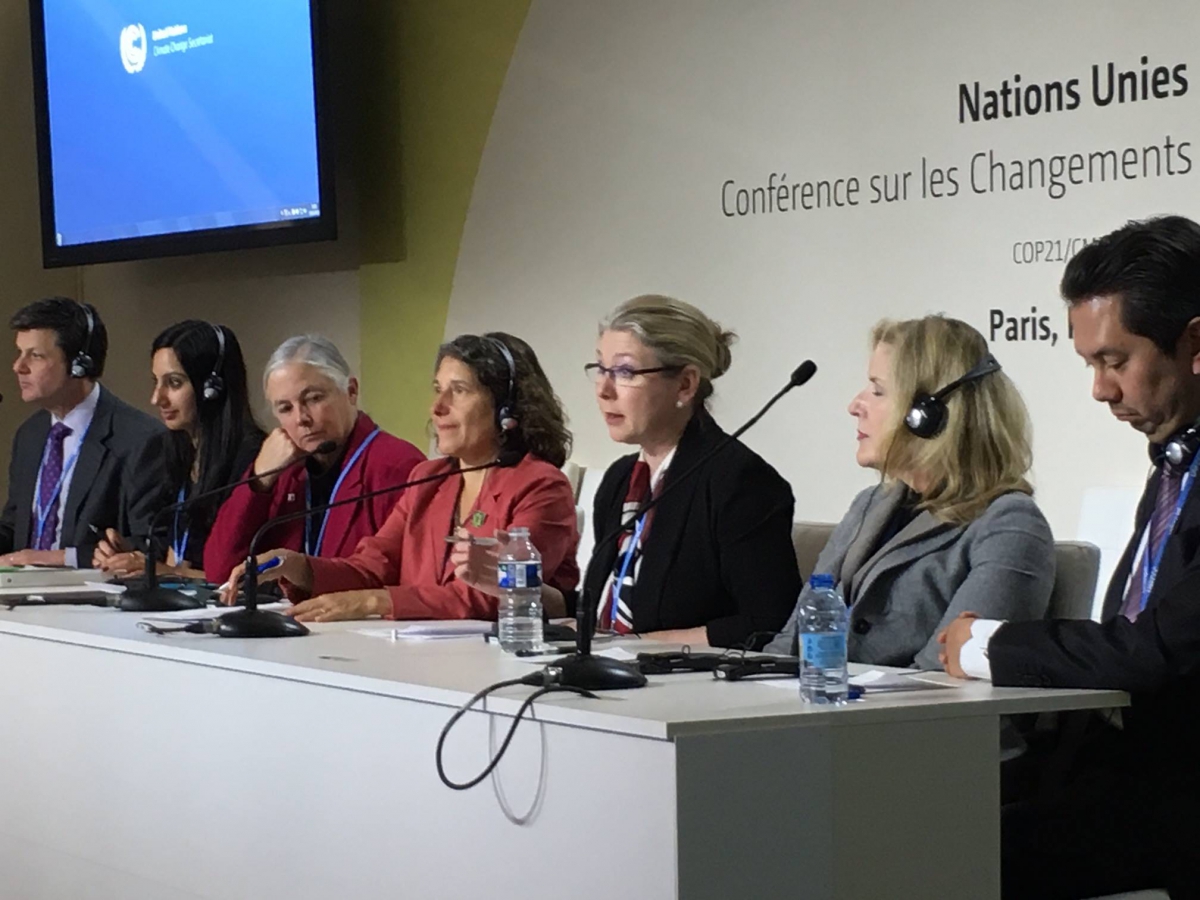 The session, co-sponsored by the Georgetown Climate Center, also highlighted some of the work already underway in U.S. states and Canadian provinces.
California State Senator Fran Pavley kicked off the session with a brief history of regulations aimed at improving the fuel efficiency of automobiles and reducing tailpipe emissions. As she described, the U.S. Environmental Protection Agency had given California authority to set its own standards because of the state’s air pollution problems. In 2002 the state passed AB1493, known as the Pavley bill, that tightened fuel economy standards, and thirteen other states signed on to join the regulations.
California’s application for a waiver from EPA in order to implement the standards was denied by the Bush Administration, but after Barack Obama became president, the government set national fuel economy and greenhouse gas emissions standards that followed the California regulations, with the backing of the car companies.
“I’m so impressed with the auto manufacturers stepping up to the plate” to develop cleaner cars, said Pavley. “They sent in their engineers, not their lawyers.”
Now, California is partnering with the car companies to provide incentives for zero emissions vehicles like electric cars, investing in charging stations, allowing electric cars in HOV lanes, and pushing a low carbon fuel standard.
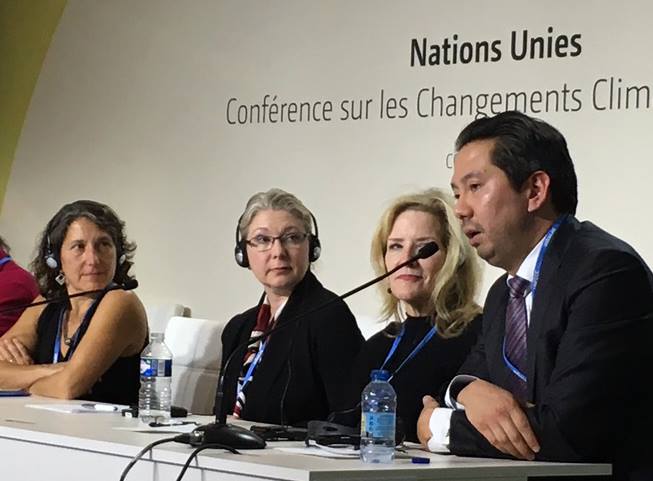 Meanwhile, in British Columbia, “we are creating the largest public charging infrastructure in Canada,” said BC Minister of the Environment Mary Polak. “Transportation is now about half of household emissions,” she explained. As such, reducing emissions from cars and trucks is crucial to meeting the province’s targets from greenhouse gas emissions reductions.
Vermont has a goal to reducing emissions 35 to 40 percent by 2030. Since nearly a third of the state’s electricity comes from renewable generation sources, “the key to our success in meeting our own law and MOU [with other states] will be converting transportation to electricity,” said Deborah "Deb" Markowitz, Secretary of the Vermont Agency of Natural Resources.
Vermont, like the other states that have adopted the California standards, is aiming “to make good our obligation to the auto industry to put policies in place” to promote electric cars, said Markowitz. Those include requiring charging stops in parking garages and charger-ready wiring in multi-family housing, and encouraging companies to provide charging at workplaces. “We know that consumers are much more likely to chose an electric vehicle if they can charge at work,” Markowitz said.
Markowitz described her own decision to buy an electric car (and the difficulty of finding a car dealer willing to sell it to her). “I love it because it is fun, and faster than my Saab,” she said. But incentives will still be needed until EVs are numerous enough to become about 15% of the fleet, when the market will be mature enough to reach a tipping point, she said. “Money on the hood makes a difference.”
Ruchi Sadhir, who serves as the top energy policy adviser to Oregon Gov. Kate Brown, described Oregon’s efforts to reduce urban sprawl and to promote transit, walking, and bicycling to reduce vehicle miles travelled and greenhouse gas emissions. The state has adopted the California fuel economy standards and has a goal of increasing the percentage of electric vehicles or plug-in hybrids on the road to 15 percent by 2025.
These efforts coincide with a shift in thinking by some auto manufacturers.
Auto manufacturers are making innovative electric cars and starting to sell them in significant numbers, said Glenn Schmidt, vice president for government affairs at BMW. “I can recall in 2009 and 2010, we were happy to have pilots of 10-20 vehicles,” he said. “Now, we have sold 21,000 i3s world-wide.” The i3 is an electric car with an optional ‘range-extender’ engine.
Making a successful transition to cleaner electric cars requires both tough regulations and consistent incentives, Schmidt said. Sales of the i3 were good in Georgia when the state was offering up to $4,500 per vehicle as an incentive to buy an electric car, he said. But the state stopped the incentive program. “When the state pulled the incentives, our sales went from more than 100 per month to 18,” he said.
Non-monetary incentives are also effective, he said. In California, “80% of our customers buy because of access to HOV lanes,” he said.
BMW is not just developing electric cars, it’s also working to reduce carbon emissions from the manufacturing process and to rethink the idea of the personal car. “We are thinking of being a mobility provider,” he explained. For instead, people could share cars instead of everyone owning a car that sits idle most of the time. “For every vehicle put in a flexible car sharing program, we can reduce [cars on the road] by three vehicles,” he said—and eventually by as many as 10.
Helen Burt, senior vice president for external affairs and public policy for PG&E Corporation, described “four ways for utilities to get engaged” in reducing emissions from transportation. They are:
Making the electricity grid stronger and cleaner.
Buying electric vehicles for their own fleets. “We now have 1,400 electric vehicles or hybrids,” said Burt. “We even have the first electric bucket trucks. They are quiet, produce no pollution, and can actually power the grid as repairs are being made so customers do not lose power.”
Building a charging infrastructure, so that customers don’t have to fear running out of juice. “Range anxiety is just today’s problem,” she said. Once enough chargers are in place, it will no longer be a problem.
Working with car companies like BMW to use demand response technologies to use plugged-in vehicles to reduce peak power demand on the grid, both by temporarily stopping charging during peak periods and by actually drawing power from plugged-in cars to help meet short peak loads.
Burt said that PG&E also “wanted to engage our own employees.” So the company started “two fantastically popular employee programs.” One offered incentives for rooftop solar; the other for electric vehicles. The latter was “so popular, we bought every [EV or plug-in] Ford and GM car west of the Mississippi,” she said.
Overall, the participants acknowledged that slashing emissions from transportation will be challenging. But they all were optimistic, especially because such cuts bring other benefits.
Pavley said the “public rallies around these policies” for at least two additional reasons other than fighting climate change. One is the health benefits from cutting traditional air pollutants. “The other is jobs,” said Pavley. She pointed out that companies like Tesla and China’s BYD are among the companies investing billions of dollars in manufacturing plants in California to build low emission vehicles (electric buses in the case of BYD). When policies both boost the economy and help the environment, she said, “that’s when we can be successful.”
This event was also co-sponsored by the Climate Action Reserve.
Watch this event:
The Subnational (State and Provincial) Foundation for Action
Wednesday, December 9, 1- 2:30 pm
Room 1, Civil Society Space (Green Zone)
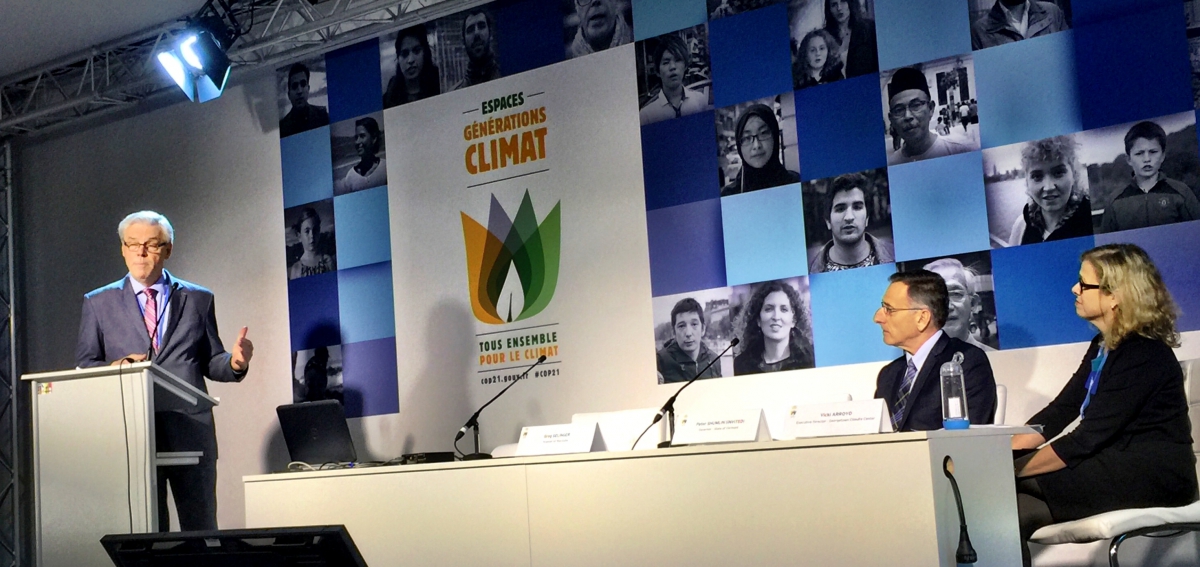 As national delegations pledge climate commitments in Paris, U.S. states are already taking action to implement these commitments. At this Georgetown Climate Center event, leaders from five U.S. states and Canadian provinces spoke about the actions their states and provinces are taking to reduce greenhouse gas emissions to combat climate change.
Vermont Governor Peter Shumlin said that he “didn’t come in [to office] as a climate warrior.” But after three storms that turned small brooks into raging torrents, killed Vermonters, and wiped out whole communities and many of the state’s roads, he had no choice, he said. Vermont has not only boosted energy efficiency in thousands of homes and added renewable power, it has actually brought down electricity rates and created thousands of new ‘green’ jobs. Just as Vermont was the first state to allow civil unions, starting the nation down the long path towards marriage equality, Vermont is trying to be leader in the transformation of the U.S. to a low carbon economy.
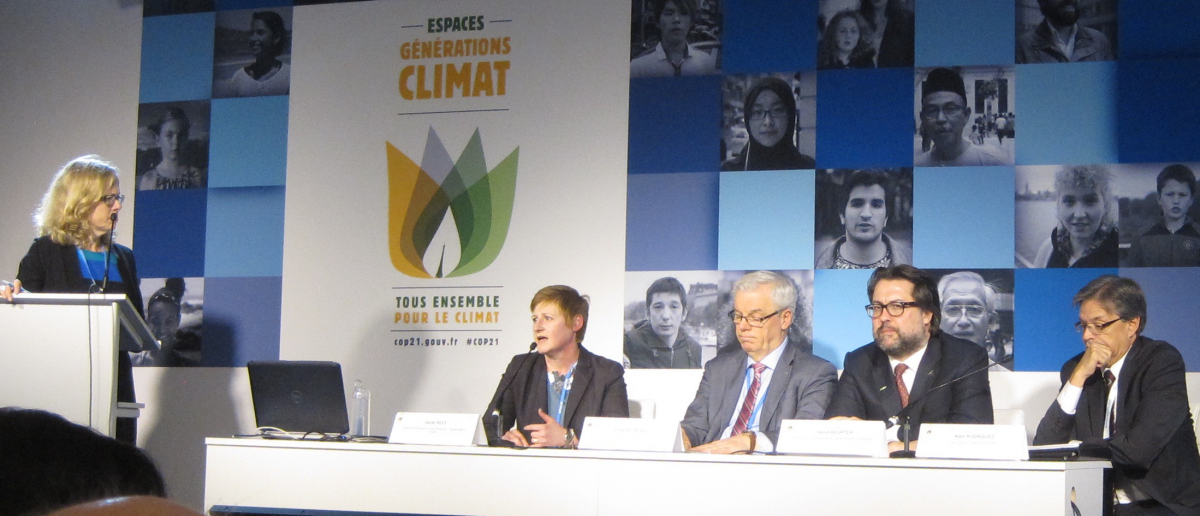 Greg Selinger, Premier of Manitoba, began by talking about the province’s 2011 flood, “the worst flood in history,” he said. “When you see those kinds of impacts, your attention is riveted,” he said. The electricity generated in Manitoba is already 98 percent renewable, thanks to the province’s rich hydro resources, so now Seligner is pushing geothermal heat pumps to replace oil furnaces, electric buses, and a cap and trade system, in addition to a tax on coal. The province is also spending many millions of dollars adapting to climate changes. One new project is the Northern Healthy Foods Initiative that promotes gardens and farms to grow vegetables and raise chickens in the northern part of the province, thus both avoiding the costs and emissions of trucking food up to northern communities and improving health.
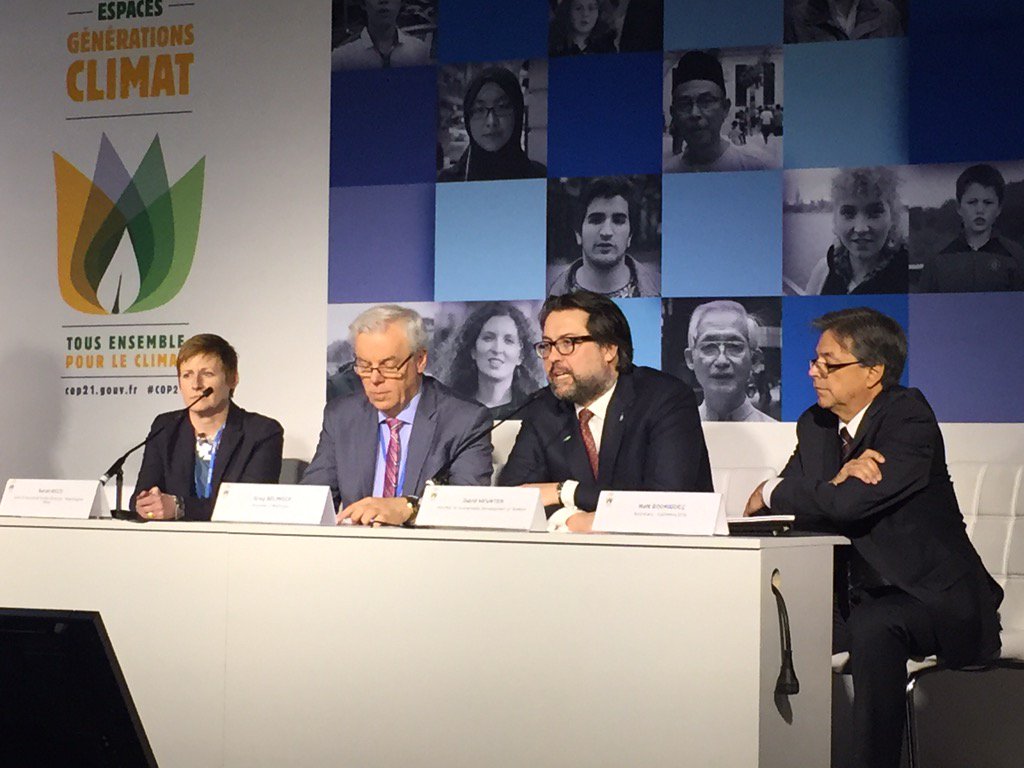 David Heurtel, Minister of Sustainable Development, the Environment and the Fight Against Climate Change for Quebec, said that the province has raised a billion dollars in the carbon markets, and invested that money in green development. About half of that money, for instance, is being used to expand public transit and offer an $8,000 per car subsidy for buying electric vehicles. “We were the first government to create such a green fund,” he said.
Sarah Rees, climate policy leader for Washington State’s Department of Ecology, describe the impacts that climate change is already having on her state. The snow pack plunged to 6 percent of its normal levels, forcing the ski season to be canceled and threatening farms that depend on irrigation as well as drinking water supplies. In addition, ocean acidification is harming the $200 million shellfish industry. “The effects are real and devastating and are getting noticed,” she said. In response, Washington State plans to impose a regulatory cap through executive order that would put a ceiling on emissions.
Matt Rodriguez, Secretary of California’s EPA, described the many actions that California has taken, from a cap and trade program that covers 80 percent of the state’s emissions to the low carbon fuel standard.
Click here for a list of recent actions by US states to cut carbon pollution.
U.S. State Leadership on Climate Change
Monday, December 7, 2015, Noon-1:30 pm
Le Bourget, Espace Génération Climat, French Pavillon
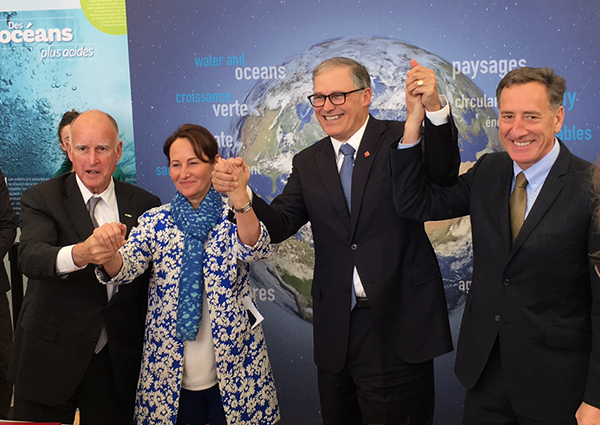 The French Embassy hosted a discussion about key actions by four US States to address climate change and boost clean energy markets and a signing ceremony with U.S. governors, pledging to work together to promote clean energy. The Georgetown Climate Center helped organize this event.
Ségolène Royal signed three joint statements on behalf of France with Jerry Brown, Governor of California, Jay Inslee, Governor of Washington State, and Peter Shumlin, Governor of Vermont to promote innovation and technology sharing in key sectors of green growth.
Ségolène Royal pointed out that “this cooperation between France and several US states will accelerate the creation of non-relocatable jobs and boost investment in the territories that are involved.”
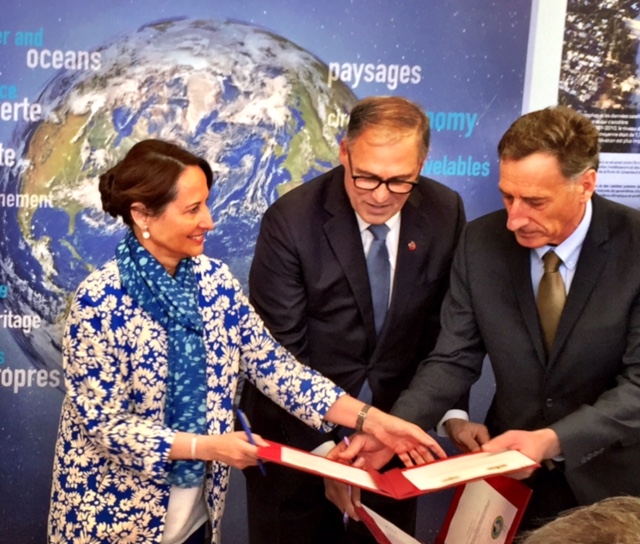 The three statements aim at further intensifying efforts towards climate change mitigation, adaptation and resilience, particularly by enhancing collaboration between local authorities. This collaboration will also address the consequences of intense climatic events such as forest fires and floods.
Furthermore, several fields of the energy transition will be subject to common approaches:
- Water management: France and the three US states will share their best practices in the field of water resource management, including agricultural water supplies, flood risk management in basins and rising water levels;
- Transport: France and the three US States will develop technological applications in strategic areas of transport (high-speed rail, zero-emission vehicles, public transport and urban planning);
-
Clean Energies: France and the three US states will share their initiatives to promote the development of renewable energy, energy storage systems, smart grids and energy efficiency technologies;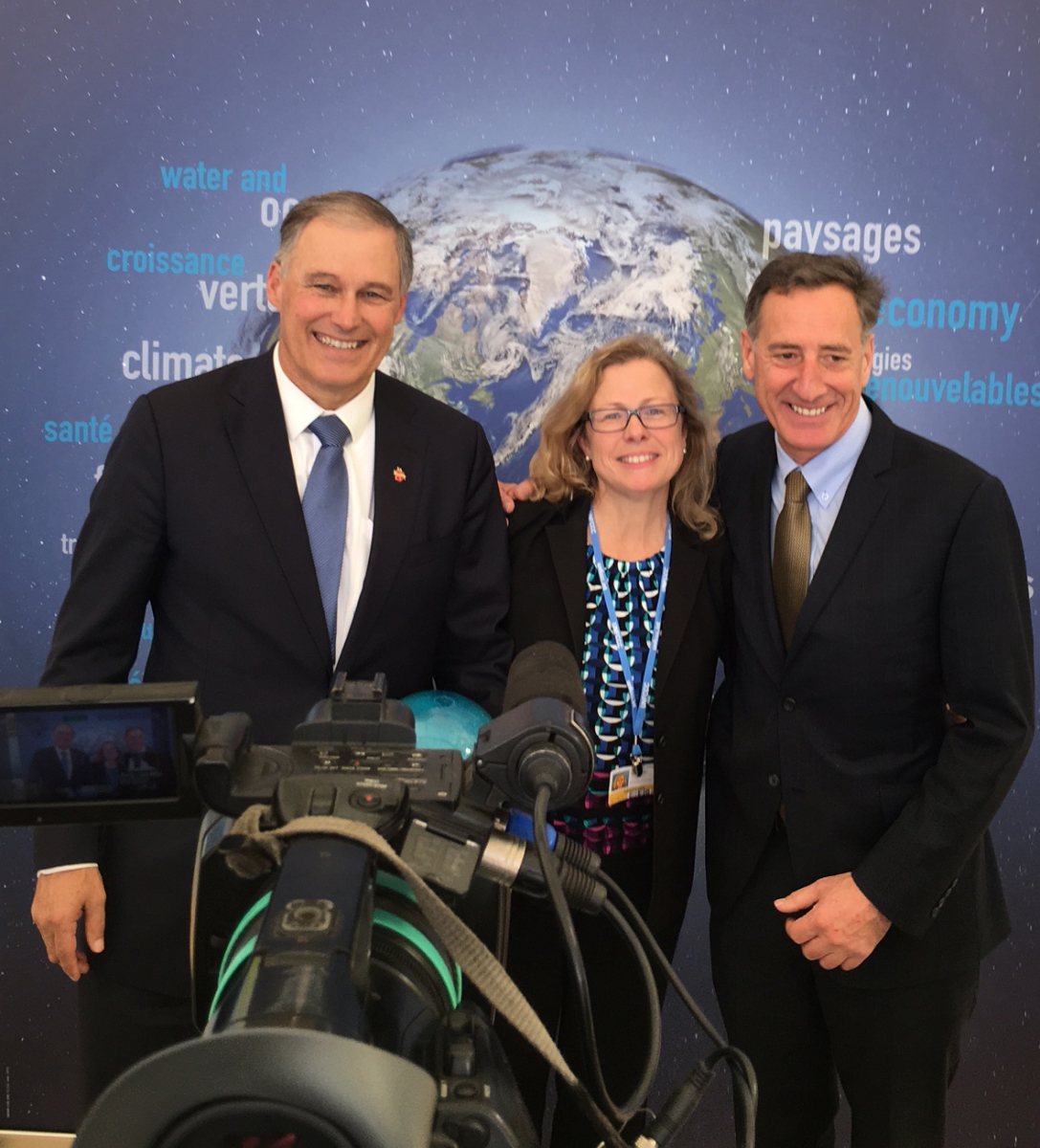
Governors Jay Inslee and Peter Shumlin chat with Vicki Arroyo of the Georgetown Climate Center. Gov. Shumlin thanked the Center for its work. - Sustainable construction and cities: France and the three US states will jointly develop innovative projects to improve the energy efficiency of buildings and develop more resilient cities;
- Collaborations at regional and local levels: France and the three US states will further develop joint research programs related to infrastructure and sustainable urban growth.
A complete agenda from the event is below:
12:00 Opening remarks: Vincent Champain, Director of Operations, GE France
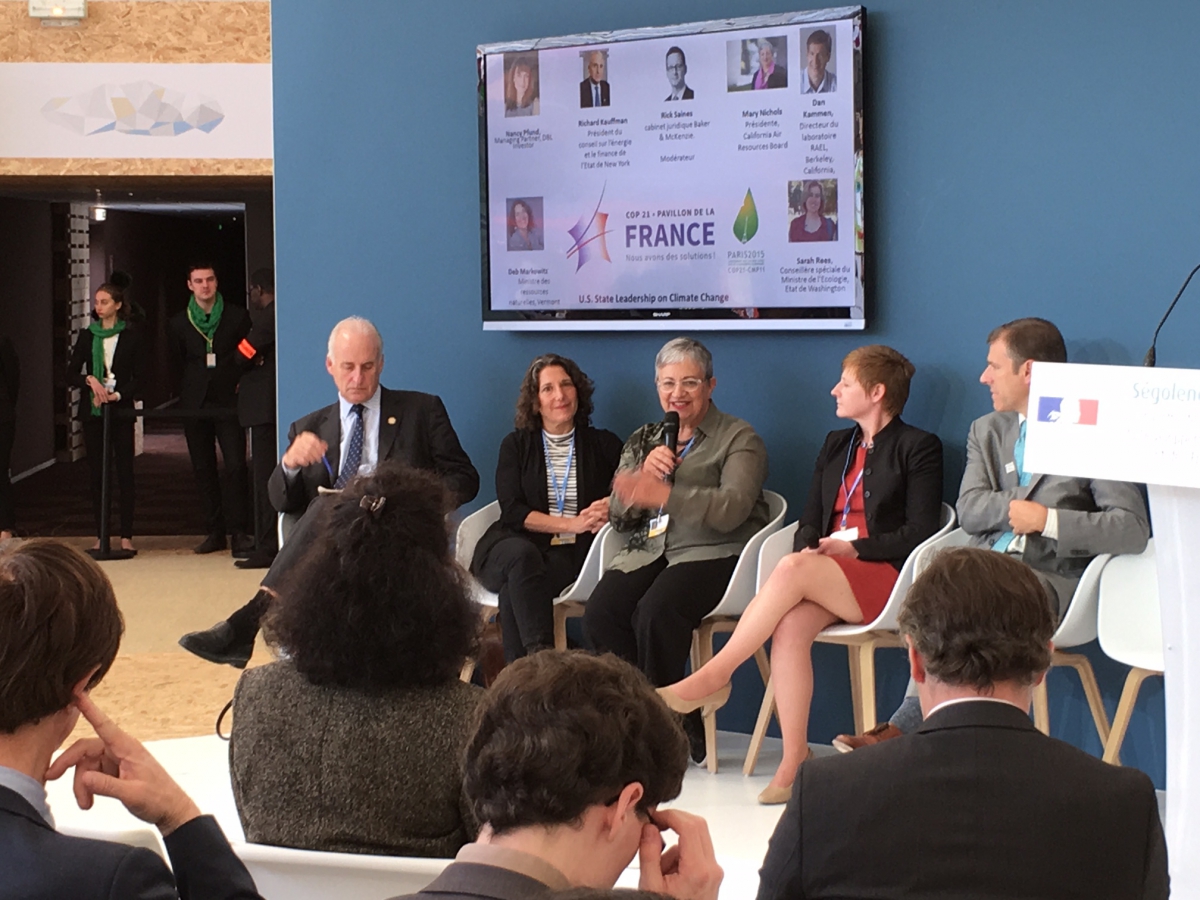 12:05 Panel
- Dan Kammen, Director of Renewable and Appropriate Energy Laboratory (RAEL) Class of '35 Distinguished Chair in Energy, University of California, Berkeley
- Richard Kauffman, Chairman of Energy and Finance, Office of the Governor, The State of New York; Chairman, NY State Energy Research Development Authority
- Deb Markowitz, Secretary of Agency for Natural Resources, Vermont
- Mary Nichols, Chair of California Air Resources Board
- Sarah Rees, Special Assistant to the Director, Washington State Dept of Ecology
- Rick Saines, Partner and Head of Environmental Markets, North America Baker & McKenzie (Moderator)
Watch this panel:
12:50 Closing Remarks: Nancy Pfund, Managing Partner, DBL Investors
12:55 Keynotes and Signing Ceremony
- Minister Segolene Royal, Minister for the Environment, France
- Governor Jay Inslee, Washington
- Governor Jerry Brown, California
- Governor Peter Shumlin, Vermont
-
Richard Kauffman, Chairman of Energy and Finance, Office of the Governor, The State of New York; Chairman, NY State Energy Research Development Authority
Watch keynotes and signing ceremony:
December 4, 2015
Prof. Joanna Lewis of Georgetown University joined senior officials from U.S. states on developments at the COP21 negotiations.

Challenges and Opportunities in China - U.S. Cooperation on Energy and Climate Change
December 1, 5-7:30 pm
China Pavilion, Le Bourget conference site (Blue Zone)
The discussion focused on enhancing the understanding of each country’s emission reduction actions, advancing the China-U.S. Joint Announcement on Climate Change, and further strengthening cooperation between the U.S. and China in the area of climate change and energy.
Speakers included experts from China’s National Center for Climate Change Strategy, China’s Ministry of Foreign Affairs, Tsinghua University, Lawrence Berkeley National Laboratory, the Energy Foundation, and Professor Joanna Lewis from Georgetown University.