

East Coast Commercial ZEV Corridor Freight Corridor Planning Project
October 18, 2023
The East Coast Commercial ZEV Corridor Project is an effort to accelerate the deployment of zero-emission electric and hydrogen-fueled trucks to reduce emissions from freight along the I-95 corridor from New Jersey to Georgia.
Launched in October 2023, the project is led by CALSTART and funded by a $1.25 million grant from the U.S. Department of Energy to accelerate the development of ZEV corridors needed to reduce greenhouse gas emissions from on-road freight transportation. Medium- and heavy-duty trucks contribute nearly a quarter of transportation GHG emissions in the United States, and a larger share of local air pollution.
Other partners in the East Coast Commercial ZEV Corridor Project include the National Renewable Energy Laboratory, Momentum, the Eastern Transportation Coalition, Dominion Energy, Exelon, and Clean Cities Coalition partners along the I-95 corridor.
 |
|
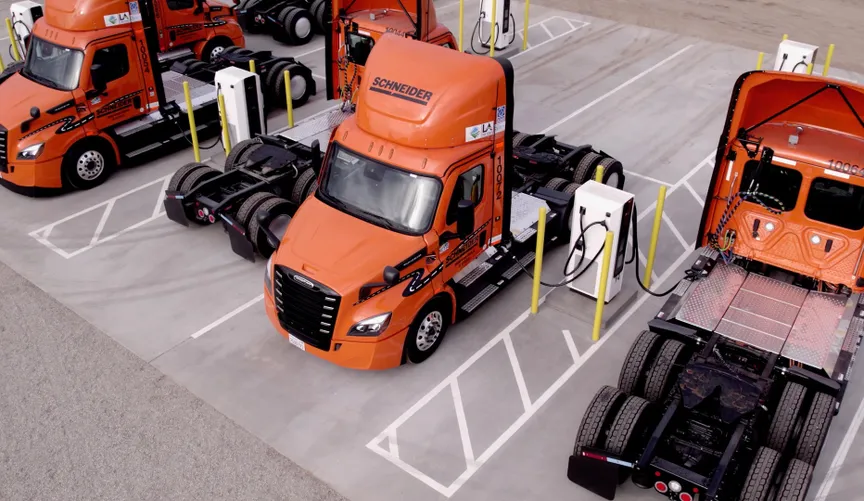
Electric heavy-duty vehicles charging. Image credit: NACFE |
This two-year project will analyze how many charging and fueling stations will be needed for the use of zero-emission freight trucks in the region, identify priority locations for initial infrastructure investments, and develop a roadmap for zero-emission freight along the east coast. The results of this effort will support strategic investments of federal infrastructure funding in EV charging and hydrogen fueling stations by state and local governments.
“Deploying a network of charging and refueling stations for zero-emission trucks is critically needed to reduce climate and air pollution from freight shipping,” said Matthew Goetz, Mitigation Program Associate Director at the Georgetown Climate Center. “Through a comprehensive, stakeholder-driven planning process, the East Coast Commercial ZEV Corridor Project will identify where and how states, utilities, and other companies can strategically build out infrastructure that supports a reliable zero-emission freight network and delivers maximum benefits to communities within the project region."
The East Coast Commercial ZEV Corridor Project will include engagement with state and local governments, local communities, truck fleet operators, the EV charging and hydrogen fueling industry, and electric utilities. This initiative will build on Georgetown Climate Center’s decade of work to convene state energy, environment, and transportation agencies in the northeast and mid-Atlantic region to coordinate EV charging infrastructure deployment and reduce transportation pollution.