

Report | Energy Policies are Key to Helping Health Care Delivery Organizations Meet Ambitious Emissions Commitments
April 12, 2023
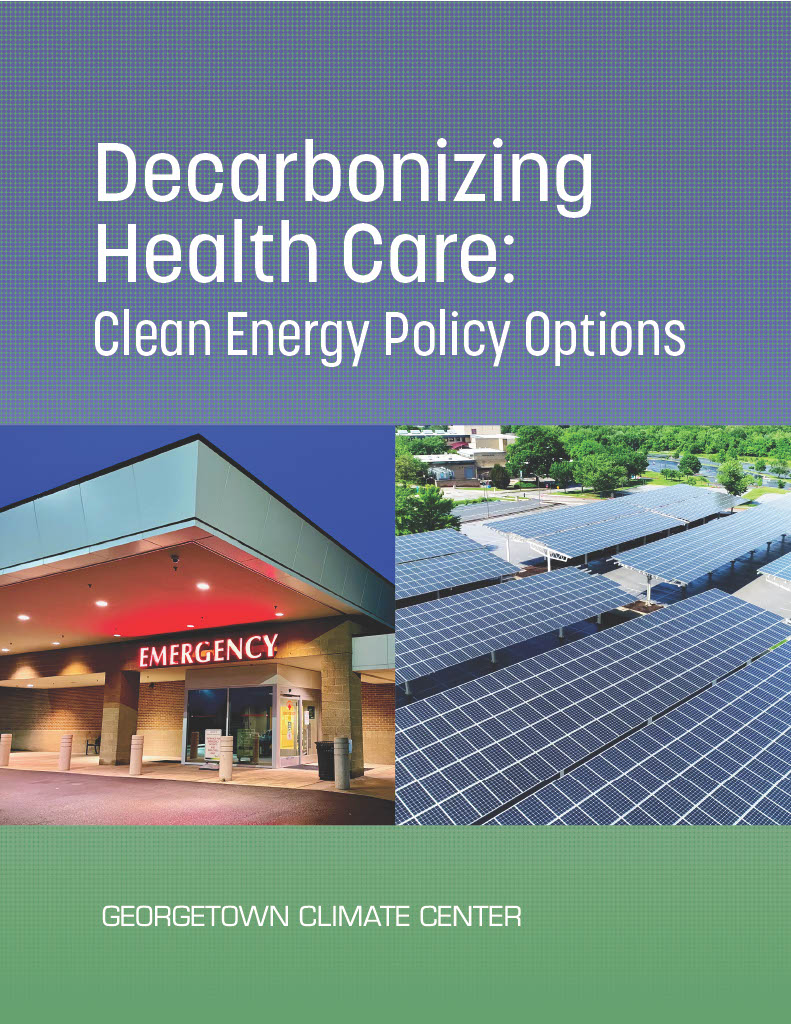 Health care delivery organizations – hospitals, clinics, and other institutions that provide health care services to patients – occupy a unique position in the climate fight: they care for people whose health is adversely impacted by climate change, and can also be a part of the solution by setting and meeting ambitious goals for reducing climate pollution. More than 100 health care organizations and companies have pledged to reduce their greenhouse gas emissions by 50-52 percent by 2030 and net zero by 2050 under an initiative sponsored by the U.S. Department of Health and Human Services.
The Georgetown Climate Center today released a new report finding that health care delivery organizations have a strong potential to help the U.S. meet emissions targets by advancing efforts to decarbonize the electricity that is consumed at their facilities and used to produce thousands of products and services in their supply chains.
The report, “Decarbonizing Health Care: Clean Energy Policy Options,” focuses on two types of energy policies that can help health care delivery organizations meet ambitious emissions targets: policies that reduce direct emissions at their facilities and policies that apply more broadly to the U.S. electric power and commercial buildings sectors.
The health care sector contributes 8.5% of overall U.S. greenhouse gas emissions, including direct emissions at facilities, emissions from electricity used at health care facilities, and indirect emissions from the sector’s supply chain of goods and services. Federal, state, and local energy and climate policies – particularly, those in the 2022 Inflation Reduction Act (IRA) – create an unprecedented new source of financing that will make it easier to invest in the up-front costs of measures that can help hospitals and other health care delivery organizations reduce their direct on-site emissions while lowering overall energy costs. However, only about 20% of the sector’s emissions come either directly from facilities or electricity used by health care delivery organizations. The vast majority of emissions – roughly 80% – are indirect, including emissions generated by the manufacture of medical supplies and medicines, as well as the carbon emissions from producing the primary materials (e.g., chemicals and plastics) used to manufacture those products.
 Fortunately, new provisions in the IRA, together with other state and federal policies, have the potential to decarbonize the broader electricity sector, an outcome that will be critical for meeting health care GHG targets as emissions that originate from electricity generation are by far the largest component of health care greenhouse gas emissions, constituting roughly 35% of the sector’s GHG footprint.
“The highest impact short-term approach for reducing these indirect emissions is to pursue federal, state, and local policies to decarbonize the broader electricity grid and reduce the embedded carbon in the electricity used to produce these products and services,” says Joe Kruger, GCC’s Director of Research and Strategy, the author of the paper. “Health care organizations can provide leadership on the development of broader electric grid decarbonization policies while simultaneously taking robust actions to reduce their onsite emissions.”
The new analysis spotlights a variety of energy policies and incentives that would have the largest potential impact on the healthcare sector’s emissions:
- Federal and state policies to accelerate decarbonization of the U.S. electric grid: Development and implementation of these policies are the responsibility of federal and state authorities, but the policymaking process would benefit from the engagement and leadership of health care delivery organizations and the wider health care sector.
- Near-term opportunities to reduce on-site emissions through leveraging new incentives in the IRA: The scope and new features of the Inflation Reduction Act can have an unprecedented impact on emissions and energy use at health care delivery organizations, including clean energy incentives available to non-profit entities and bonus provisions for projects undertaken in disadvantaged “energy communities” and environmental justice communities.
- Approaches to decarbonize heating and on-site fuel at hospitals and other health care facilities: Healthcare delivery organizations could play an important leadership role in identifying technologies, roadmaps, and policies for decarbonizing their own facilities and the broader commercial buildings sector. A health care sector initiative to identify approaches for reducing emissions from on-site burning of natural gas in boilers could be particularly valuable.
“Decarbonizing Health Care: Clean Energy Policy Options” also encourages the U.S. Department of Health and Human Services to fund research to resolve outstanding questions about health and indoor air quality associated with ventilation systems because approaches that meet critical indoor air safety and infection control needs and energy efficiency objectives could have a significant impact on reducing fossil fuel use in hospitals.
“With a sustained and integrated effort, the health care sector has an opportunity to reduce its own greenhouse gas footprint, improve health and welfare for local communities, and provide leadership for the broader clean energy transition in the U.S. economy,” said GCC’s Joe Kruger.
With support from the Commonwealth Fund, the Georgetown Climate Center is reviewing federal and state energy policies that could help health care delivery organizations meet ambitious greenhouse gas reduction targets. This includes policies to reduce fossil-fuel use at health care facilities and shift to clean electricity, reduce transportation emissions from health care–related vehicles and fleets, increase resilience from extreme weather events and provide cleaner air for communities near health care delivery facilities, and drive reductions in supply chain emissions.