

Report | The Storage Solution: How Batteries Can Enhance Grid Reliability, Affordability, and Decarbonization in the Data Center Era
October 26, 2026
New report from Georgetown and Duke universities offers recommendations tailored for vertically integrated and restructured regulatory contexts
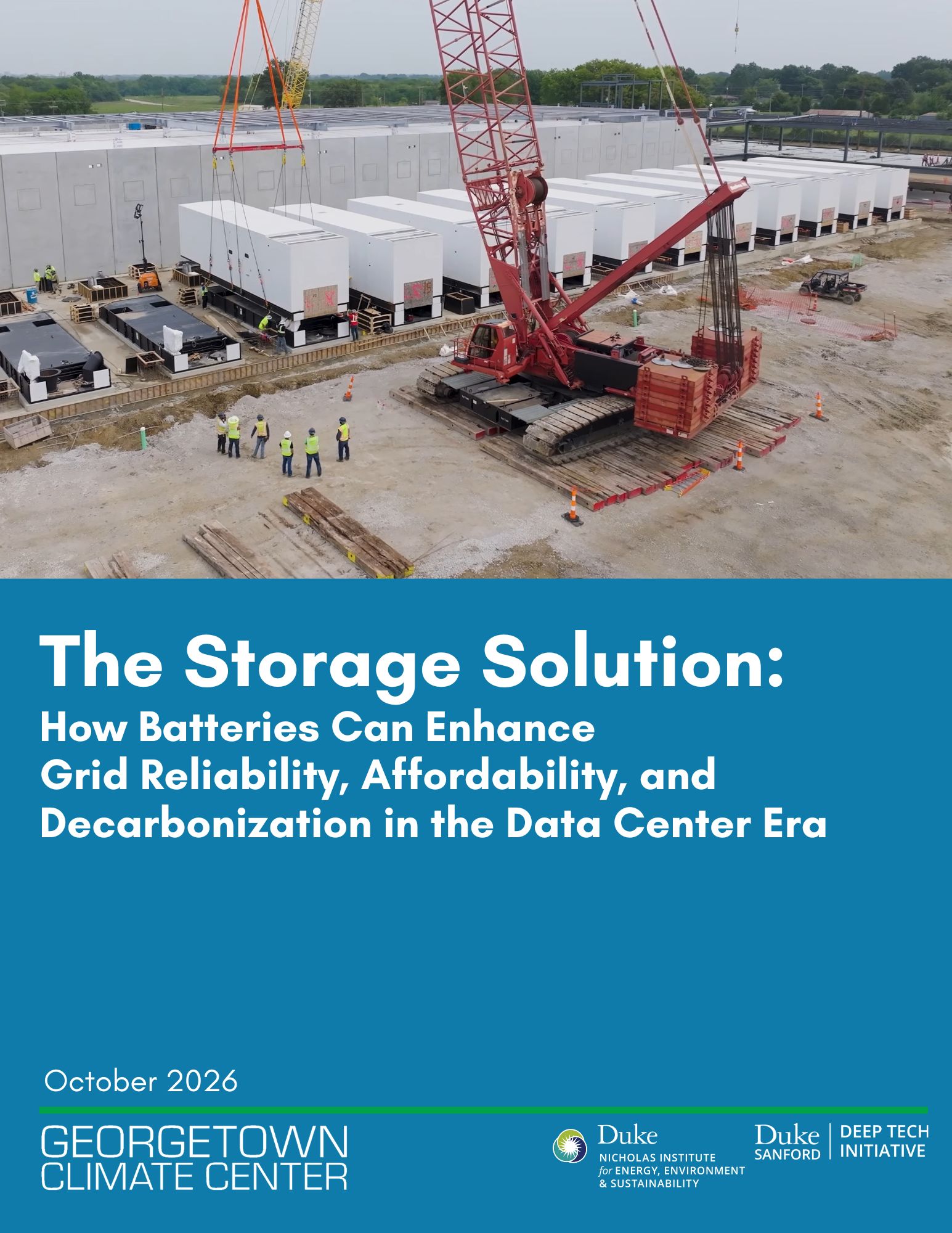
Rising electricity demand in the United States complicates efforts to reduce greenhouse gas emissions and address climate risks, while also raising cost and grid stability issues. In The Storage Solution: How Batteries Can Enhance Grid Reliability, Affordability, and Decarbonization in the Data Center Era, a new report published today, the Georgetown Climate Center, the Nicholas Institute for Energy, Environment and Sustainability at Duke University, and the Deep Tech Initiative at Duke’s Sanford School of Public Policy observe that widespread deployment of energy storage systems, including batteries, has the potential to alleviate some of the major challenges associated with data centers and other large electric loads. However, the benefits of energy storage will only be realized with an enabling policy environment that recognizes the values that batteries and other energy storage systems can provide to the grid, including state-level policy.
“Our energy system is at a key inflection point, and the decisions made by policymakers, utilities, and hyperscalers about how to meet the large load growth challenge will be critical to maintaining an affordable, reliable, and clean electric system,” write the report’s coauthors, Nathan Burnand (Georgetown Climate Center) and Ian Hitchcock (Duke University). “State policymakers and other regulators who act proactively can capture the economic and environmental benefits of energy storage while also utilizing these solutions as tools to promote affordability and grid reliability.”
Potential benefits of energy storage highlighted in the report include:
- Rapidly deploying added capacity to the electric grid without the need for expensive power generation or transmission infrastructure construction;
- Enabling participation in peak shaving, virtual power plant, and demand response programs for both large loads and residential customers;
- Providing backup power and islanding capabilities for data centers and other large loads without producing particulate or greenhouse gas pollution; and
- Maximizing the value of renewable energy by storing it when it is plentiful, and dispatching it onto the grid when it’s needed.
The report offers distinct policy solutions for states with vertically integrated utilities (which operate both generation and distribution of electricity) and restructured regulatory contexts (in which those functions are separated). Potential solutions in vertically integrated states include “Bring Your Own New Clean Energy" tariffs (BYONCE) and integrated planning reforms. For restructured states, potential solutions include enhanced planning coordination, the establishment of ambitious battery storage deployment goals, and incremental storage procurement alongside new large loads.
“Ultimately, battery storage has the potential to help mitigate many of the risks that data center growth poses to the electricity system,” the authors write. However, they point out, the details matter. “Ten-gigawatt data centers powered by behind-the-meter natural gas are a design choice, not an inevitability. Battery storage can give policy makers flexibility to chart a different path forward for the electricity system.”
Read the full report here
Links to related resources:
- Issue Brief | Building Local Governance Structures for Evaluating Data Center Proposals (September 3, 2026)
- Issue Brief | What to Make of Data Center Moratoriums? (August 12, 2026)
- Issue Brief | State Utility Tariffs: A Tool to Manage Large Load Growth (March 20, 2026)
- Blog | “Large Electric Loads”: What They Are, Why They Matter, and What States Can Do (November 18, 2025)
- Toolkit | Local Ordinances to Help Bring Data Centers into Alignment with Climate Goals (November 5, 2025)