

BLOG | Bipartisan Infrastructure Law Funding has the Potential to Reduce GHG Pollution from Transportation in New Jersey
May 10, 2023 | by Ryan Levandowski and James Bradbury
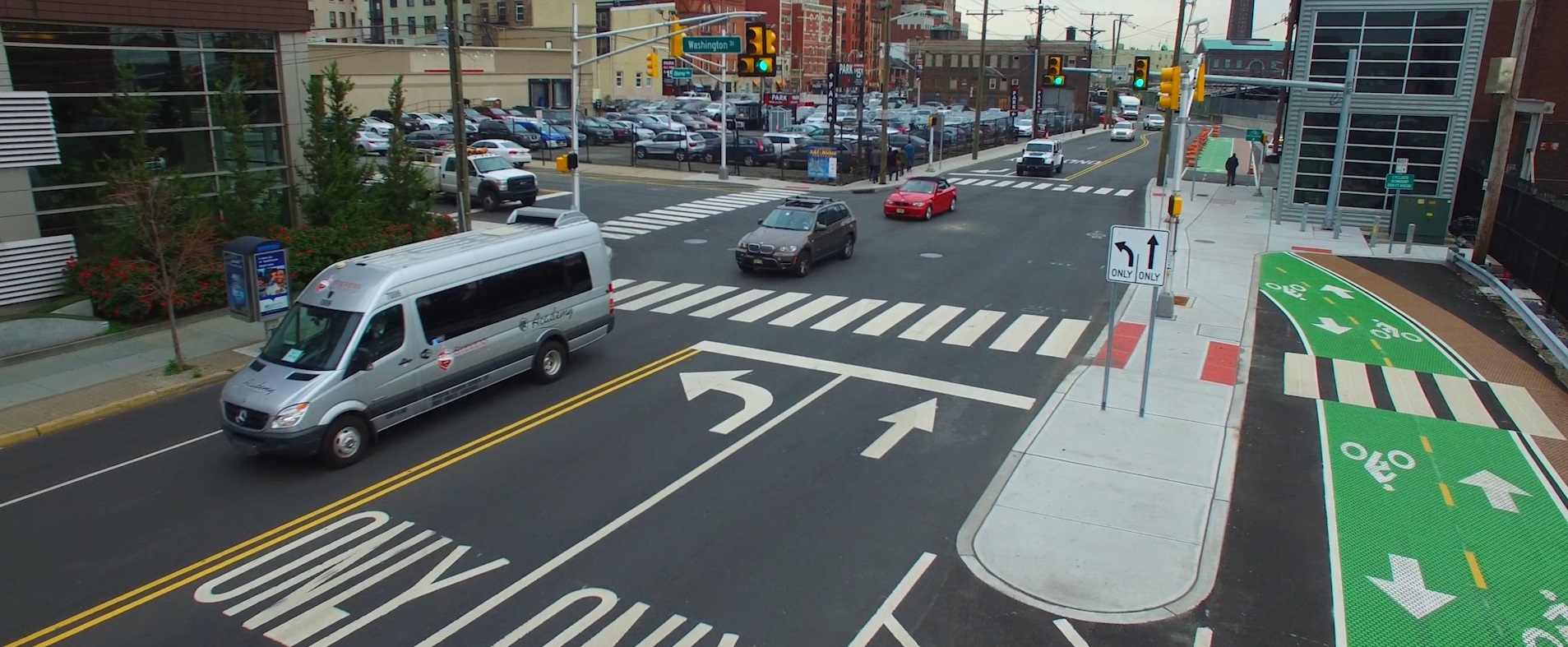
Image from the NJ Dept. of Transportation
Transportation accounts for more than 45 percent of New Jersey’s carbon dioxide emissions, making that sector by far the largest contributor to statewide greenhouse gas (GHG) emissions.See footnote 1 As in other states with ambitious climate commitments, New Jersey will need to address transportation emissions in order to meet its climate pollution reduction targets. The Georgetown Climate Center (GCC) modeled several potential scenarios and found that the nearly $17 billion in funding New Jersey could receive from the federal Bipartisan Infrastructure Law (BIL) will either help or hinder those efforts, depending on how the transportation dollars are spent.
New Jersey’s Ambitious GHG and Transportation Goals
Under New Jersey’s Global Warming Response Act (GWRA), passed in 2007 and updated in 2019, the state established a goal to reduce GHG emissions by 80 percent below 2006 levels by 2050. According to estimates in the most recent GWRA report, published by the New Jersey Department of Environmental Protection (NJ DEP) in the fall of 2020, the Garden State will need to reduce GHG emissions from transportation by 87 percent in order to meet that goal. To achieve these deep reductions, NJ DEP estimates that:
- 88 percent of new light-duty vehicles sold in the state will need to be zero-emission by 2030, rising to 100 percent of sales by 2035, and
- 75 percent of medium-duty and 50 percent of heavy-duty trucks on the road will need to be zero-emission by 2050.
Achieving these ambitious targets will require a sustained focus and substantial commitments to expanding low-carbon transportation options in New Jersey.
New Jersey policies and programs aim to reduce GHG emissions through vehicle electrification
 |
|
As part of the NJ Climate Change Research Center's Climate Academy, GCC's James Bradbury presented on ways New Jersey could harness BIL funding for transportation pollution reduction. Learn more and view a recording of the webinar. |
New Jersey has already taken significant steps to address one part of transportation decarbonization: electrification of passenger and freight vehicles. Current policies and programs in New Jersey aim to increase the share of zero-emission vehicles (ZEVs) on the state’s roads and in its communities. This includes commitments to advancing regulations that will help the state achieve its ambitious electric vehicle deployment goals for light-duty, medium-duty, and heavy-duty vehicles. In particular, New Jersey is working to adopt and implement California’s Advanced Clean Cars II and Advanced Clean Trucks rules, respectively, which together would require increasing shares of all new passenger and freight vehicles sold in the state to be ZEVs.
New Jersey has also committed over a hundred million dollars from Regional Greenhouse Gas Initiative proceeds and Volkswagen settlement funds toward bus and truck electrification, with a focus on providing benefits to overburdened communities. Particulate and other pollution from diesel trucks and buses is a major contributor to respiratory illnesses, and low income communities and people of color are disproportionately exposed to that pollution. Steps to electrify heavy-duty diesel vehicles are also effective GHG emission reduction strategies that come with fuel savings for fleet owners, in addition to their substantial public health benefits.See footnote 2
Initiatives that seek to reduce emissions across the entire transportation system will necessarily include strategies beyond vehicle electrification. Policies that promote public transit, shared mobility, and active transportation can help to achieve deep emissions reductions and ensure that the benefits of clean transportation investments reach individuals regardless of whether they drive, walk, bike, or ride public transit. Along these lines, the New Jersey GWRA report outlines further steps for the state to pursue to reduce transportation emissions, including increasing transit ridership, expanding transit-oriented development, and reducing single-occupancy vehicle trips.See footnote 3
Bipartisan Infrastructure Law funds can help New Jersey reduce emissions across the transportation system
The historic infusion of federal transportation dollars coming from the BIL gives New Jersey an opportunity to make a down payment on a variety of important low-carbon transportation investments. Leveraging federal funds could not only reduce emissions, but also help ensure that the benefits of a cleaner, multi-modal transportation system reach communities that are overburdened by pollution and underserved by the current system.
Importantly, the BIL has ample flexibility that enables New Jersey to leverage new and expanded sources of funding for ZEVs, transit, and other modes to achieve its GHG emission-reduction goals. However, investments of federal transportation funding will only help cut carbon emissions if New Jersey policymakers direct those investments toward low-carbon strategies and avoid locking in high-carbon infrastructure projects, like expanded highways.
Building on an earlier, national-level analysis of the potential GHG impacts of BIL investments, GCC recently partnered with RMI to model how different approaches to investing federal transportation dollars could affect GHG emissions at the state level. Applying a comparable analysis to New Jersey reveals some of the ways that investment of federal dollars could affect progress toward the state’s climate goals.
Our approach: Hypothetical investment scenarios illustrate a range of possible outcomes
We estimate that $16.7 billion from BIL could flow to New Jersey for surface transportation-related projects over five years, from 2022 to 2026. State Departments of Transportation (DOTs) and transit agencies are guaranteed to receive a majority of that amount according to formulas established by Congress.See footnote 4 However, the final total will ultimately depend on the extent to which the state applies for and receives additional competitive grant awards administered by the federal government. In addition to the guaranteed formula funding, our analysis includes a reasonable estimate of the amount that New Jersey could receive from those competitive federal grants.
To reflect the flexibility that federal law allows states to wield when investing federal funds, we developed three scenarios to explore how New Jersey might choose to invest its share of BIL funds.
- High emissions scenario: Investment decisions favor highway expansion and otherwise do not account for the potential carbon emission impacts of their transportation projects.
- Low emissions scenario: Includes far fewer investments in highway expansion and a more climate-conscious approach to prioritizing investments of transportation infrastructure dollars.
- Very Low emissions scenario: No investments of BIL dollars are made in highway expansion, and all other investments of these funds prioritize cutting carbon pollution to the maximum extent legally allowed. This scenario assumes that states take advantage of their authority to “flex” up to half of the dollars in the National Highway Performance Program into the Surface Transportation Block Grant program (to make a broader range of low-carbon project types eligible for investments using BIL dollars).
Figure 1. Investment Portfolios for the Three Scenarios Analyzed, $16.7 Billion
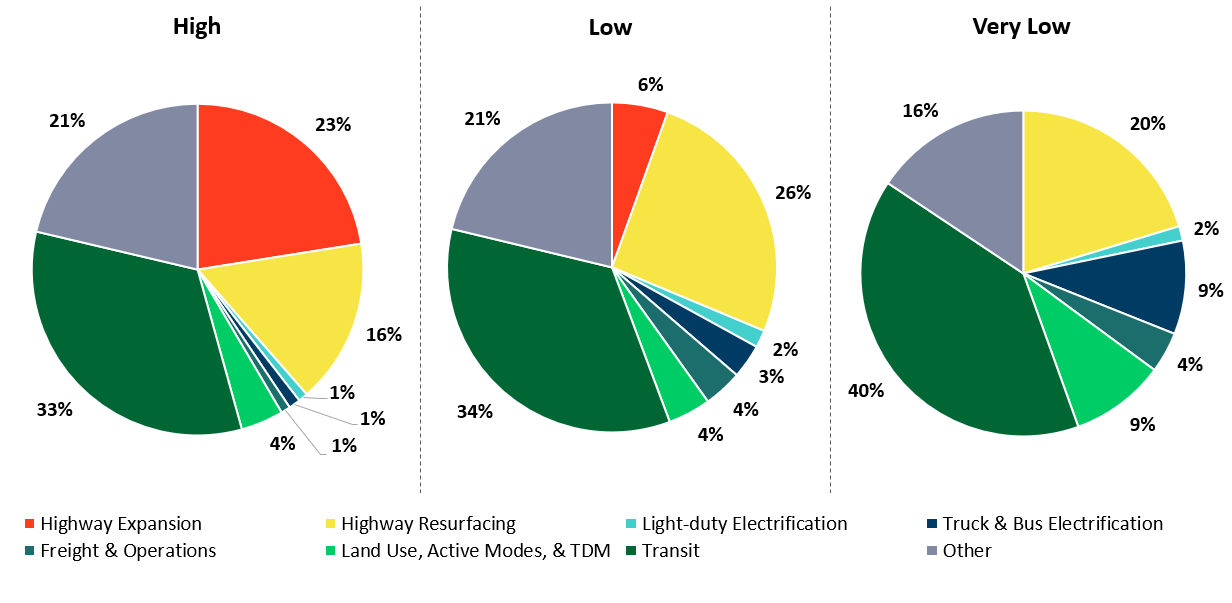
Investments shifted from highways to electrification, transit, and active modes in lower emissions scenarios
We modeled the emissions effects of the different investment priorities under each of the three scenarios using GCC’s Transportation Investment Strategy Tool. Each of these investment pathways represents a hypothetical scenario. Taken together, they illustrate that a broad range of potential emissions outcomes is possible, depending on current and future investment decisions, which are related to state and federal transportation and climate policies.
Results: BIL dollars have the potential to reduce transportation emissions in New Jersey, but investment decisions matter
The results of our analysis find that the BIL has the potential to bend the curve down on transportation emissions in New Jersey, but it could also result in emissions that are higher than business as usual, depending on the state’s investment decisions.
Figure 2. Projected Annual Transportation Emissions by Scenario, New Jersey (MMT CO2e)
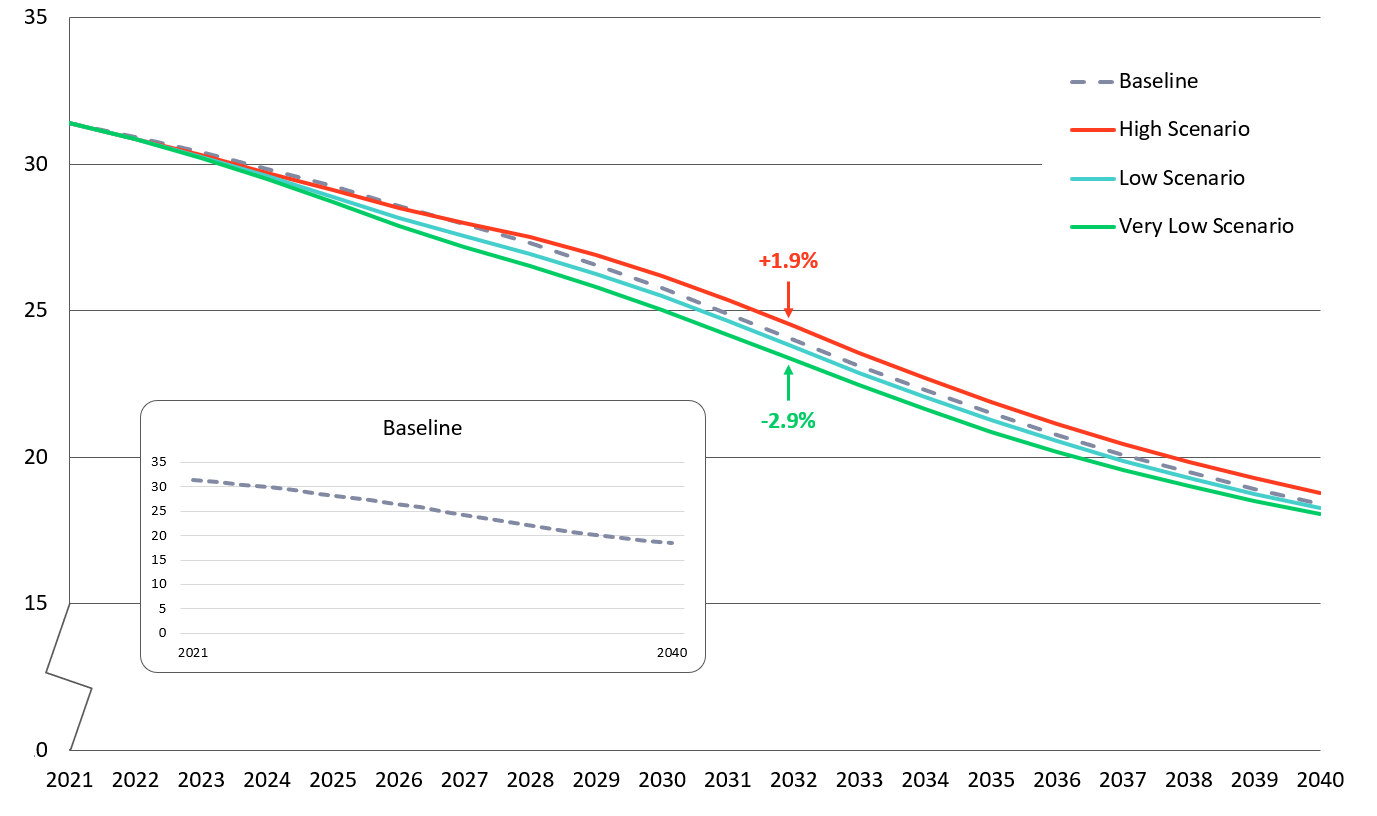
Investment decisions can result in nearly 5 percent difference in annual emissions by 2032
Under the High emissions scenario, emissions are reduced over the first few years, relative to the baseline, but then trend upward to nearly 2 percent above the GHG baseline by 2032. This is caused by investments in highway expansion and the effect of “induced demand.” At first, when lane miles are added to highways and arterial roadways, there is a near-term, temporary effect of reducing congestion. However, within a few years, the additional lane capacity fills up again, increasing the overall number of vehicle miles traveled.See footnote 5 Importantly, the line graph above demonstrates that the upward pressure on emissions caused by capacity expansion projects can last for decades.
By contrast, the Low emissions scenario results in emissions that are 1 percent below the baseline in 2032. This reduction in emissions is roughly equivalent to cutting the annual emissions from more than 55,000 gasoline-powered passenger vehicles.See footnote 6
The Very Low scenario suggests it is theoretically possible for New Jersey to more than double its emission reductions compared to the Low emissions scenario. With maximal “flexing” of federal funds toward low-carbon strategies and without any investment in highway expansion, a nearly 3 percent emissions reduction below baseline is possible in 2032.
A comparison between the High and Very Low scenarios shows a nearly 5 percent swing in transportation-related carbon pollution in 2032 based solely on investment decisions.
Percentage of funding invested in highway expansion is main driver of emissions outcomes
To look at how the various investment strategies factored into our overall results, these stacked bar charts show the cumulative changes in emissions through 2040, relative to our baseline.
Figure 3. Cumulative Change in On-Road Transportation GHG Emissions for NJ, 2022-2040
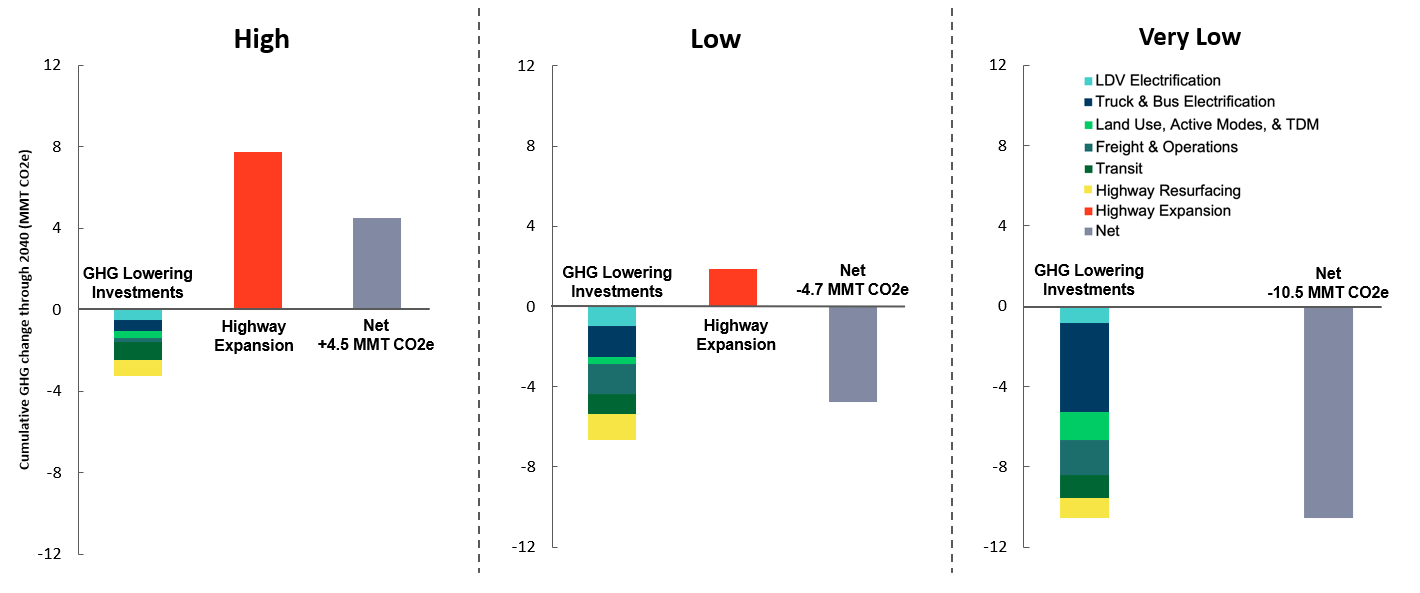
GHG emissions outcomes in New Jersey span 15 MMT CO2e in cumulative emissions
In each chart, the red bar shows the emissions impact of highway expansion investments and their upward pressure on future emissions. The multi-colored bars, on the other hand, show the emissions-reducing benefits of the various low-carbon transportation investments New Jersey could fund with its share of the BIL.
What we found is that if highway expansion projects are limited (as, for example, in the Low and Very Low emissions scenarios), then the BIL presents a substantial emissions-reduction opportunity (reducing New Jersey transportation emissions cumulatively by 4.7 MMT CO2e or 10.5 MMT CO2e respectively). The law includes funding for a large range of strategies that can help to reduce emissions, and these scenarios take advantage of that. It is important to emphasize that formula-funded federal highway programs provide flexibility for states to invest transportation dollars in accordance with their own policy priorities. For example, the National Highway Performance Program (NHPP) -- the largest formula-funded federal program – allows states to direct program dollars toward projects that improve highways and arterial roadways not just for cars, but also by making them more accessible and safer for a variety of users, including electric transit buses, cyclists and pedestrians.See footnote 7
On the other hand, those emissions reductions can be reversed by relatively modest investments in highway expansion. As demonstrated in the High emissions scenario, investing about 25 percent of the total surface transportation dollars into highway expansion projects could more than cancel out the emissions-reduction benefits of all of the other low-carbon transportation investments funded by the BIL, resulting in 4.5 MMT CO2e more total carbon pollution than what would happen without the law.
The bottom line is that the percentage of funding invested in highway expansion versus other strategies is the main driver for the transportation emissions outcomes of the BIL, when comparing these investment scenarios.
Policy Considerations for New Jersey
Federal programs provide ample flexibility for states to “choose their own adventure” in ways that could help or hurt their efforts to achieve climate policy goals. The good news is that while state and local transportation planners need to respond to a wide range of social, economic, and environmental needs when making investment decisions, many of those needs are complementary and consistent with a low-carbon future. In addition to the climate benefits, cutting pollution from transportation can be key to providing many substantial public health,See footnote 8 economic, and social benefits.See footnote 9 Although our model does not capture the localized distributional effects of low-carbon transportation investments, state and local officials can look to capitalize on the additional benefits that improved clean transportation access can offer to overburdened populations and underserved communities.
A 3 percent improvement over business as usual – the potential GHG emissions reduction achievable in ten years if New Jersey dedicates all BIL resources to climate-friendly projects – is the equivalent of eliminating the emissions from more than 150,000 gasoline-fueled passenger vehicles. That would be major progress for New Jersey, and points toward an opportunity to build on the state’s leadership on vehicle electrification and take further steps to cut emissions from transportation through strategies that boost transit ridership and reduce trips in single-occupancy vehicles.
Although the funding from BIL only runs through 2026, those investments will have a lasting impact. Furthermore, those five years of investments can be viewed as a first installment that could be supplemented by other policies and future investments. Future funding in subsequent federal transportation reauthorization bills could be similarly leveraged to continue driving reductions beyond those shown in our analysis – potentially bending New Jersey’s emissions trajectory by additional percentage points in either direction, depending on how the dollars are spent.
It is also important to note that federal dollars represent just over half of New Jersey’s total transportation funding. State and local transportation agencies also draw from a variety of other funding sources, which come with their own project eligibility and spending requirements. Just as with the BIL, the decisions made about how to invest those other state and local funds will factor into the final emissions outcomes.
At the federal level, the Biden administration has set national goals to reduce emissions from transportation as well as other sectors, including net-zero GHG emissions across all sectors by 2050 with an interim target of 50 to 52 percent reduction below 2005 levels by 2030. In January 2023, the U.S. Environmental Protection Agency along with the Departments of Energy, Transportation, and Housing and Urban Development released the U.S. National Blueprint for Transportation Decarbonization, which includes inter-agency strategies and actions needed to reduce emissions from transportation in order to meet national climate goals. New Jersey, and other states, can draw on key takeaways from the national blueprint, including the importance of collaboration between agencies with jurisdiction over transportation, energy, climate, housing, and land use. Such coordination is key to effective implementation of strategies like improving coordination between land-use and transit planning, as recommended in the New Jersey GWRA report.
Going forward, it is important for state DOTs and Metropolitan Planning Organizations throughout the country to make addressing climate change a policy priority. As a start, this means accounting for the GHG performance of transportation projects when making decisions about investments in infrastructure that will, in many cases, last for generations. Making this standard practice will be a crucial step for New Jersey to meet their ambitious emission reduction targets.
Endnotes:
1
1. In 2020, according to the EIA’s State Energy Data System. Table 3, State energy-related carbon dioxide emissions by sector, View Source. | Back to contentBack to content
2
2. See Transportation, Equity, Climate, and Health Program, Harvard T.H. Chan School of Public Health, View Source. | Back to contentBack to content
3
3. Table 1.8. Recommendations for reducing vehicle miles traveled, New Jersey’s Global Warming Response Act Report (2020),View Source. | Back to contentBack to content
4
4. Jeff Davis, “Biden Signs Bipartisan Infrastructure Bill Into Law,” Eno Center for Transportation (Nov. 19, 2021), View Source. | Back to contentBack to content
5
5. Susan Handy, Increasing Highway Capacity Unlikely to Relieve Traffic Congestion, UC Davis: National Center for Sustainable Transportation (2015), View Source. | Back to contentBack to content
6
6. Greenhouse Gas Equivalencies Calculator, U.S. Environmental Protection Agency, View Source. | Back to contentBack to content
7
7. For more, see: “Flexible Federal Funding Opportunities for State and Local Clean Transportation Investments.” Back to contentBack to content
8
8. Shahram Heydari et al., Potential health benefits of eliminating traffic emissions in urban areas (2022); View Source. | Back to contentBack to content
9
9. Cecilia Briceno-Garmendia, Wenxin Qiao, & Vivien Foster, The Economics of Electric Vehicles for Passenger Transportation (2023), View Source. | Back to contentBack to content