

BLOG | Signs of Progress: US DOT enables EV charging station logo signs along highways
February 2, 2024
By Matthew GoetzSee footnote 1
Recent action by the federal government to allow businesses with electric vehicle (EV) charging stations to appear on highway logo signs is a chance to create a better driving experience for EV drivers. It could also help boost the EV transition and ease range anxiety by increasing visibility of EV charging stations, but realizing these benefits will require action by state DOTs.
 |
|
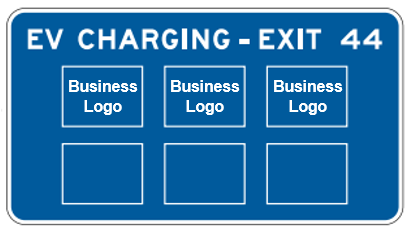
Above: A sample template of a highway sign indicating which businesses nearby have electric vehicle charging from the U.S. Federal Highway Administration Manual on Uniform Traffic Control Devices for Streets and Highways |
Last month, the U.S. Federal Highway Administration (FHWA) published the updated Manual on Uniform Traffic Control Devices for Streets and Highways (MUTCD), the federal guidebook that sets the rules governing road signs and pavement markings to promote safe and efficient travel. Updates to the MUTCD, which is revised every four years by the FHWA and adopted by states, can have significant real-world impacts improving safety and convenience for pedestrians, bikers, and vehicle drivers on highways across the nation.
It hasn’t received much fanfare, but the 11th Edition National MUTCD includes an important change that could dramatically improve the experience of driving an electric vehicle (EV), and could even accelerate adoption of zero-emission vehicles. For the first time, the Manual will allow businesses with EV fast charging stations to be featured on “specific service” signs – the business logo signs most drivers are familiar with for gas stations, restaurants, and hotels near highway exits.
FHWA has added a new category of these logo signs for “EV Charging,” an update that will make it easier for electric vehicle drivers to find a charging station as easily as a gasoline-fueled driver can currently find a filling station.
GCC worked with states and other partners to inform this federal action
This change to the manual is an important update for EV drivers, as the previous edition of the MUTCD (as well as the proposed update released for public comment in 2021) did not allow logo signs for EV charging stations.See footnote 2 The inclusion of these signs in the final 2023 MUTCD update was informed by states across the country leading on EV deployment, who provided input reflected in a comment letter submitted by the Georgetown Climate Center describing the importance of EV-charging-specific service signs. GCC also worked with the Northeast States for Coordinated Air Use Management (NESCAUM), the National Association of State Energy Officials (NASEO), and other organizations to engage with state officials from energy, environment, and transportation agencies through meetings and webinars to support additional comments by states that informed FHWA’s update to the manual. This collaboration built on innovative efforts by state departments of transportation in California, Colorado, and Connecticut to use highway signs to promote convenient EV charging.
EV logo signs can play an important role as we build the national charging network
Logo signs are important for current EV drivers, providing both convenience and increased safety by enabling drivers to navigate without looking at their phones to find EV fast charging locations while on the road. The addition of these EV charging logo signs will have an additional benefit: soon, all drivers on the road could see the rapidly growing number of EV fast charging stations along highways. Availability of charging stations is a major concern limiting EV adoption in the U.S., with the vast majority of Americans believing it is difficult to find charging. Having the logos prominently posted on highway signs will build broader awareness of the growing network of EV charging stations along highway corridors.
The increased visibility of charging stations provided by highway logo signs can be an important complement to the rapid investment in and deployment of EV charging infrastructure across U.S. highways. This action is well timed, as states across the country install fast charging stations along highway corridors, funded by Bipartisan Infrastructure Law programs such as the National Electric Vehicle Infrastructure (NEVI) Formula Program and the Charging and Fueling Infrastructure (CFI) Grant Program.
Action by state DOTs will be needed to bring these EV charging signs to roads around the country
While the federal action lays the framework for better awareness of EV charging stations, state departments of transportation will need to take action to realize the benefits of the new traffic sign manual. States are required to adopt the federal manual or update their state manuals in line with new rules by January 2026, but they have the flexibility to take action sooner. In addition to quickly putting these new rules into action, states can start now to engage with businesses offering EV fast charging (including those receiving funding from NEVI or CFI grants) to make them aware of the opportunity to be added to logo signs. For example, state DOTs can highlight this opportunity on their websites and other materials related to logo signs. (The highway logo signs are funded by the private businesses appearing on the signs.) Other organizations engaged in EV charging awareness efforts – such as the U.S. Department of Energy Clean Cities Coalitions and other EV advocacy groups – can also support this effort.
The recent change to the MUTCD is an important step by FHWA to enable the adoption of electric vehicles, and is part of a broad approach by the federal government to make driving an EV more affordable and more convenient. As EV adoption is one of the major strategies for cutting climate pollution from transportation – the leading source of emissions in the United States – it is important for state DOTs to implement the new EV sign guidelines as soon as possible. As these new signs begin to appear on interstates and state highways, they will help guide drivers and businesses toward a zero-emission transportation future.
Endnotes:
1
1. With research contributions by Georgetown Climate Center Research Assistant Angie Lai. Back to contentBack to content
2
2. The last major update to the MUTCD, released in 2009, generally prohibited EV charging stations from appearing on “specific service” logo signs. Businesses that qualified for a different category of specific service sign–such as for gas, lodging, or food–and also had an EV charging station, could add an EV CHARGING “word banner” of text under their logos. However, this provision restricted the businesses who could qualify for a logo sign and significantly limited the visibility of EV charging stations. Back to contentBack to content