

GCC Unveils Updates to State Adaptation Policy Tracker
October 22, 2026
First Installment covers Delaware, DC, Maryland, Pennsylvania, Virginia, and West Virginia
For more than a decade, Georgetown Climate Center has tracked U.S. state laws and programs through its State Adaptation Policy Tracker and its Adaptation Clearinghouse.
Today GCC released the first installment in a comprehensive update to the State Adaptation Policy Tracker to reflect the growing depth, breadth, and complexity of climate adaptation policy at the state level. The Tracker will now cover all 50 states and the District of Columbia, with new ways to navigate and explore. Each state profile shares a common structure, including an executive summary, a risk profile, descriptions of its adaptation governance, law and policy, investments and funding, and links to related entries in GCC’s Adaptation Clearinghouse.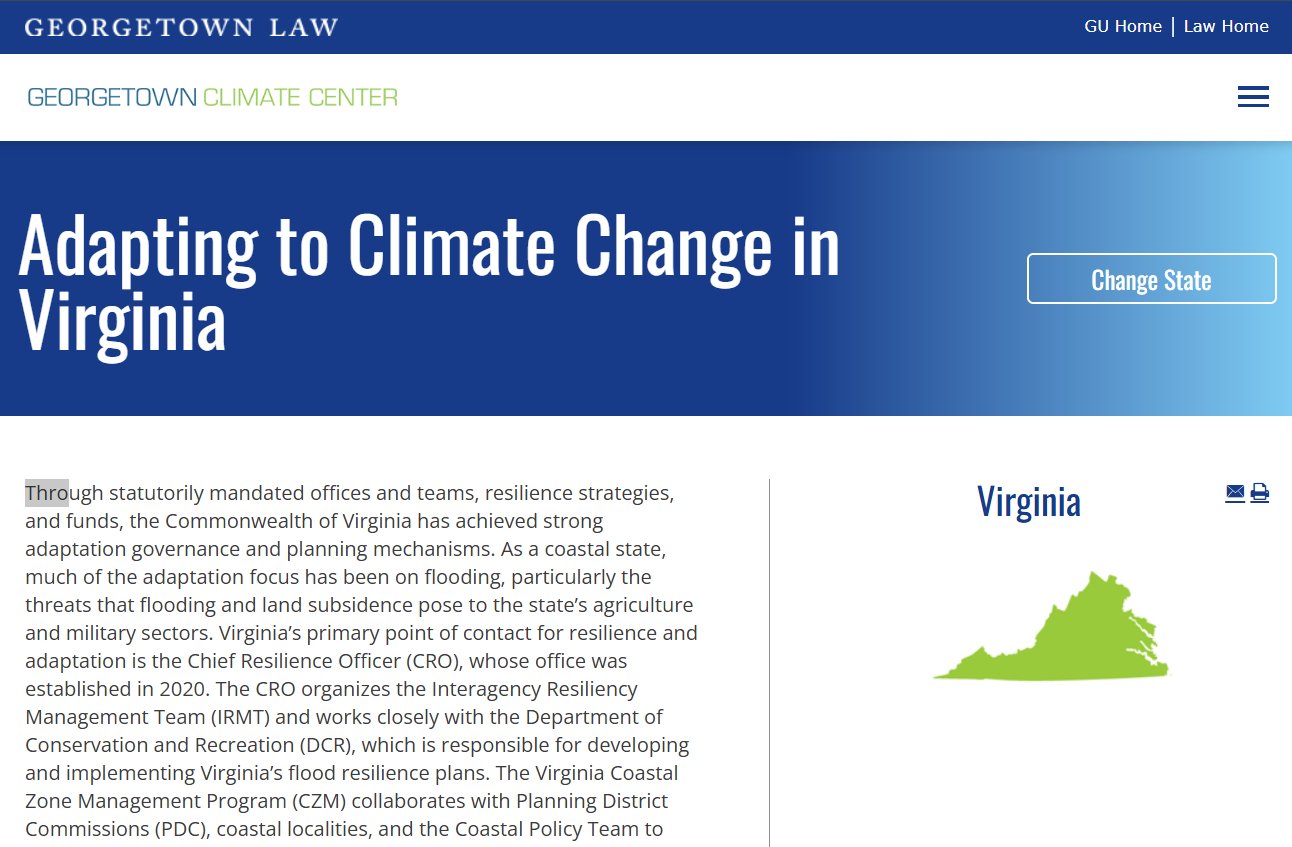
“The field of climate adaptation policy is evolving quickly, and state governments are looking to each other for proven solutions and innovative approaches,” said GCC Institute Associate Marisa Borregine, who has led the re-tooling of the Adaptation Tracker with Climate Fellow Sidney Lee. “Our Adaptation Policy Tracker is one of the most frequently cited features on our web site, and the updates we’re initiating today will make sure anyone who’s interested can find up-to-date information about the steps states are taking to respond to climate-driven hazards.”
When GCC launched the Tracker in 2014, only a handful of states had put formal adaptation plans and policies into action. Today, every state has increased its focus on adaptation and resilience. From establishing Chief Resilience Officers and setting up dedicated revenue streams to pay for adaptation initiatives, to creating incentives for strengthening homes and harnessing land conservation as an adaptation tool, states are moving quickly to protect people and communities from climate-driven hazards.
Over the coming months, GCC will release updated state profiles in batches corresponding to FEMA’s regions, which groups together states that often face the same climate driven hazards, such as hurricanes and wildfires. Today’s update covers FEMA Region 3, which covers the mid-Atlantic states of Delaware, the District of Columbia, Maryland, Pennsylvania, Virginia, and West Virginia. New regional updates will be announced periodically over the coming months; all updates are expected to be completed before the end of 2027. A color-coded interactive map and banners on each page will show when each state’s profile was last updated.
“State and local governments across the country are responding to the growing danger storms, heat waves, floods, fire, and drought pose to people and communities,” said GCC’s Adaptation Program Director, Joshua Saks. “Our goal is to make sure our Tracker reflects the full scope of what’s happening out there today, and helps leaders learn from each other and match solutions to the challenges they are facing.”