

Local Ordinances to Address Freeboard Standards
Freeboard Standards: Improving freeboard standards so that buildings in flood-prone areas are elevated above the expected levels of current and future floods.
- Local Ordinances to Address Freeboard Standards (PDF)
- Potential for implementation in Maryland, New York, Connecticut, and Maine (PDF)
About
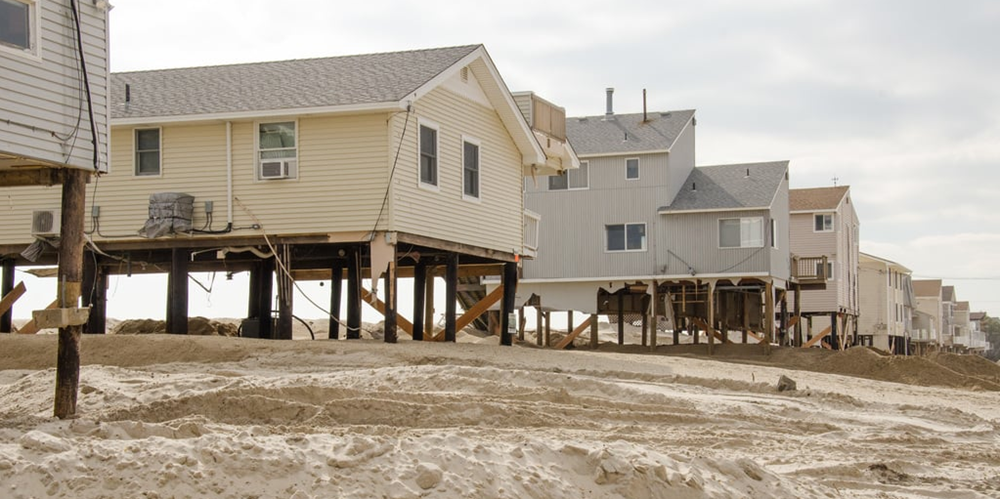
Faced with increasing flood risk, communities have two meaningful ways to reduce risk: 1) reduce the number of structures and people in flood-prone areas, and 2) raise buildings higher than the water is expected to rise. Higher elevation above expected high-water levels (generally called “freeboard”) protects homes and people from flooding. Freeboard regulations generally start by defining the projected flood levels from 100- or 500-year storms, and setting an additional elevation above which buildings (or some subset of structures) must be raised. Different elevations may apply to different buildings based on their risk tolerance. For example, local regulations might require that critical facilities, such as hospitals and fire stations, be elevated to higher levels than private homes or businesses.
This reduction in risk exposure benefits municipalities by making infrastructure more insurable and improves bond ratings, which in turn reduces the cost of borrowing for local governments. Here, we present two models of floodplain standards that go beyond the federal minimum for freeboard elevation. We propose that localities adopt the American Society of Civil Engineers (ASCE) 2024 floodplain standards, and engage with communities to agree upon shared planning horizons and future sea-level rise scenarios to inform local freeboard values. State and local-level floodplain ordinances are an effective way to mitigate against increased coastal and riverine climate hazards. However, freeboard ordinances must be coupled with other floodplain management regulations to sufficiently address local flood risk. We recommend that coastal and riverine communities adopt a floodplain ordinance that includes several elements related to freeboard: 1) expand the flood-prone area where development is regulated to include the 500-year floodplain; 2) incorporate local future sea-level rise into freeboard values; 3) elevate critical facilities higher than other buildings; 4) adopt the most restrictive (i.e., highest) freeboard value when regulations overlap; and 5) use community input to determine a shared, risk-informed future sea-level scenario and planning horizon.
Read Previous Section Read Next Section
Back to top