



Informing Federal Standards to Reduce Carbon Pollution
Georgetown Climate Center conducts legal and policy analysis, facilitates dialogues between federal and state agency leaders, and convenes states and stakeholders to inform the development of federal standards to reduce carbon pollution from the power sector. In December 2022, GCC submitted comments to the U.S. Environmental Protection Agency (EPA) on behalf of the Northeast and Mid-Atlantic Power Sector Policy Forum that expressed support for “strong standards of performance for existing coal-, oil- and natural gas-fired power plants” in order to significantly reduce greenhouse gas emissions from the electricity sector.
Convening States and Stakeholders
Georgetown Climate Center convenes states and other stakeholders to discuss opportunities for state leadership on climate and clean energy. The facilitation of regional and multi-state forums, including through the Conveners Network and the States Deployment Initiative, informs the development and implementation of federal policies and programs and serves as a resource for states. GCC’s Northeast and Mid-Atlantic Power Sector Policy Forum brings together state energy, environment, and utility regulatory agency officials in 11 states to support the transition to cleaner energy in the region.
Georgetown Climate Center also facilitates engagement by subnational leaders, including governors and state agency leaders, in international climate policy development.
Adaptation Clearinghouse: Energy Sector
An online database and networking site that serves policymakers and others who are working to help communities adapt to climate change. This page includes resources to help policymakers understand, plan, and prepare for impacts of climate change to the energy sector, ranging from changes in energy demand to preparing for threats to energy infrastructure.
Reducing Emissions from the Health Care Sector
With support from the Commonwealth Fund, the Georgetown Climate Center is reviewing federal and state energy policies that could help health care delivery organizations meet ambitious greenhouse gas reduction targets. This includes policies to reduce fossil-fuel use at health care facilities and shift to clean electricity, reduce transportation emissions from health care–related vehicles and fleets, increase resilience from extreme weather events and provide cleaner air for communities near health care delivery facilities, and drive reductions in supply chain emissions.
Mitigation Policy Considerations for the Maryland Commission on Climate Change
February 2, 2017
In this memorandum, the Georgetown Climate Center identifies mitigation issues that may be of interest to the Maryland Commission on Climate Change as it reports on the status of Maryland’s climate change efforts, develops recommendations for legislative action, and develops workplans for 2017 and beyond.
State Leadership Driving the Shift to Clean Energy: 2016 Update
November 14, 2016
A new report from the Georgetown Climate Center shows that a dramatic shift to clean energy is taking place across the U.S. The report features profiles of 19 diverse states.
Comments on Clean Power Plan Federal Plan Requirements and Model Trading Rules
January 21, 2016
The Georgetown Climate Center submitted comments in response to the proposed Clean Power Plan Federal Plan Requirements and Model Trading Rules. These comments were built on discussions the Center had with states as they consider their options for developing plans, and on prior research conducted by the Center on the linking of subnational emissions trading programs, but they do not necessarily reflect the views of individual states.
Memorandum: Policy Considerations for the Maryland Climate Change Commission
November 22, 2015
This memorandum identifies policy issues that may be of interest to the Maryland Climate Change Commission as it drafts its November 2015 report on the status of Maryland’s climate change efforts and recommendations for legislative action,1 and as its considers topics for its 2016 agenda. This memorandum focuses on issues relating to the evaluation of Maryland’s progress towards its 2020 goal with regard to fuel switching in the power sector, projected changes in vehicle miles traveled, and future growth of electric vehicles. It also provides context regarding other states that have set emission reduction goals for years between 2025 and 2035, and identifies potential additional emission reduction policies that could achieve reductions in future years.
Supporting State Plan Compatibility and Interstate Compliance with the Clean Power Plan
July 7, 2015
The Georgetown Climate Center has released a working paper identifying opportunities for guidance and tools from the Environmental Protection Agency to support the development of state plans that are compatible with each other, and facilitate interstate compliance with the Clean Power Plan. As states and stakeholders consider options to comply with EPA’s Clean Power Plan requirements to reduce emissions from the power sector, there is growing interest in developing individual state plans that give regulated entities the option of working across multiple states to achieve compliance.
Single State Clean Power Plan Compliance Approaches with Interstate Elements
May 28, 2015
The Georgetown Climate Center has released a policy brief providing an overview of considerations for single-state Clean Power Plan compliance plans that would allow for the option of interstate trading of compliance instruments. This document examines how such programs could work under both rate-based and mass-based models of compliance.
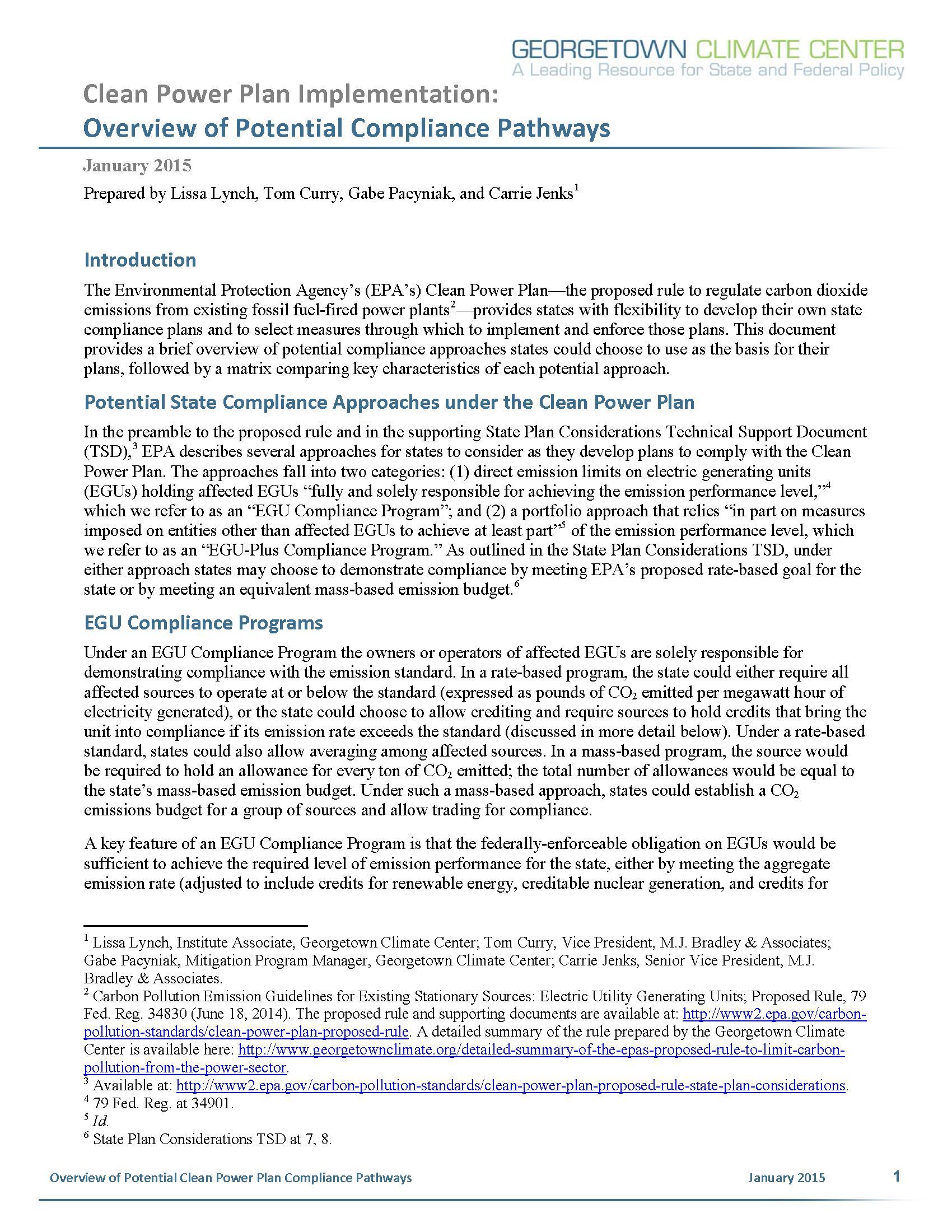
An Overview of Potential Clean Power Plan Compliance Pathways
January 14, 2015
The Georgetown Climate Center has released a policy brief highlighting potential approaches that states could use to comply with the EPA's Clean Power Plan—the agency's proposed rule to limit carbon pollution from the power sector.
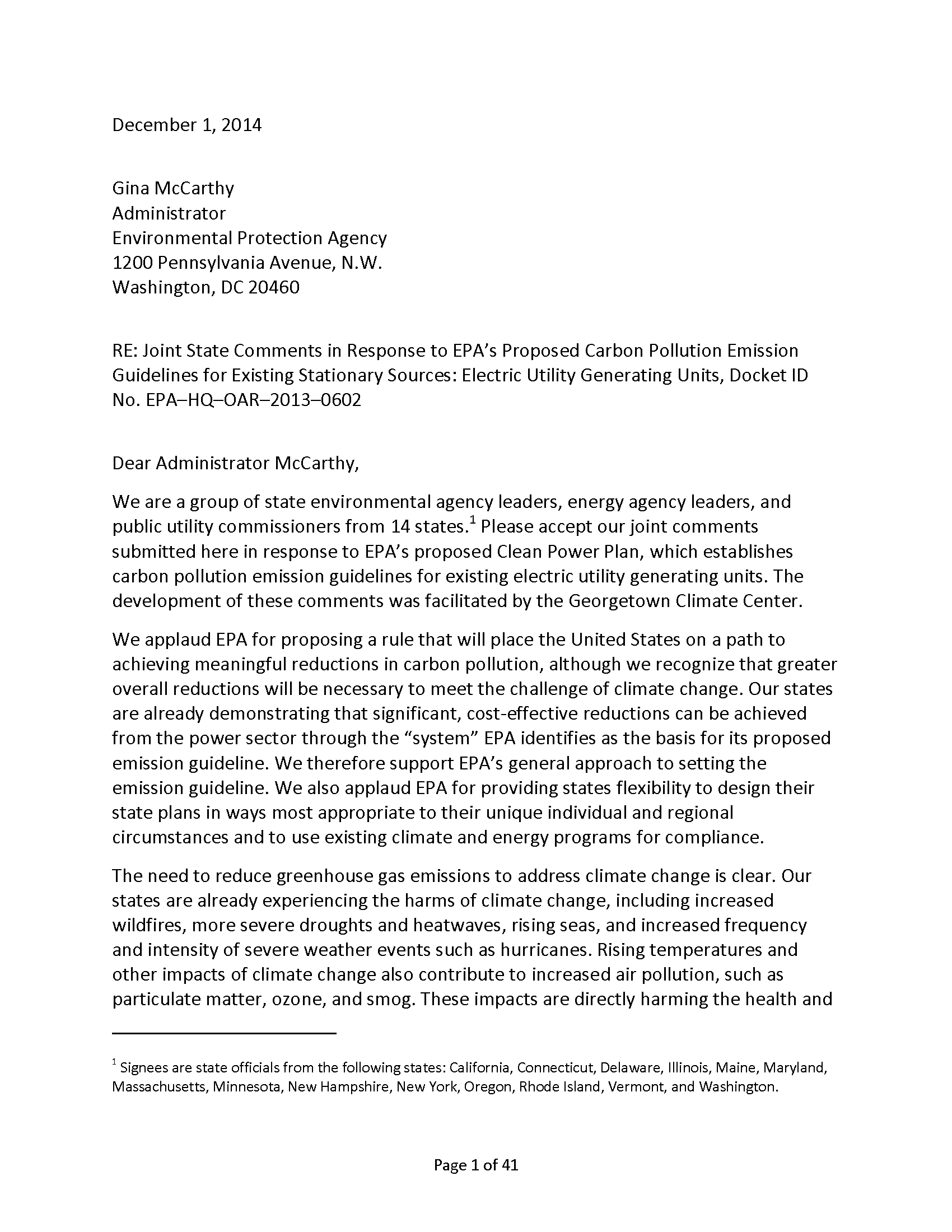
States Voice Strong Support for EPA’s Proposed Clean Power Plan
December 1, 2014
In a letter to U.S. EPA Administrator Gina McCarthy, environment and energy leaders from 14 states expressed strong support for the agency’s proposed Clean Power Plan.
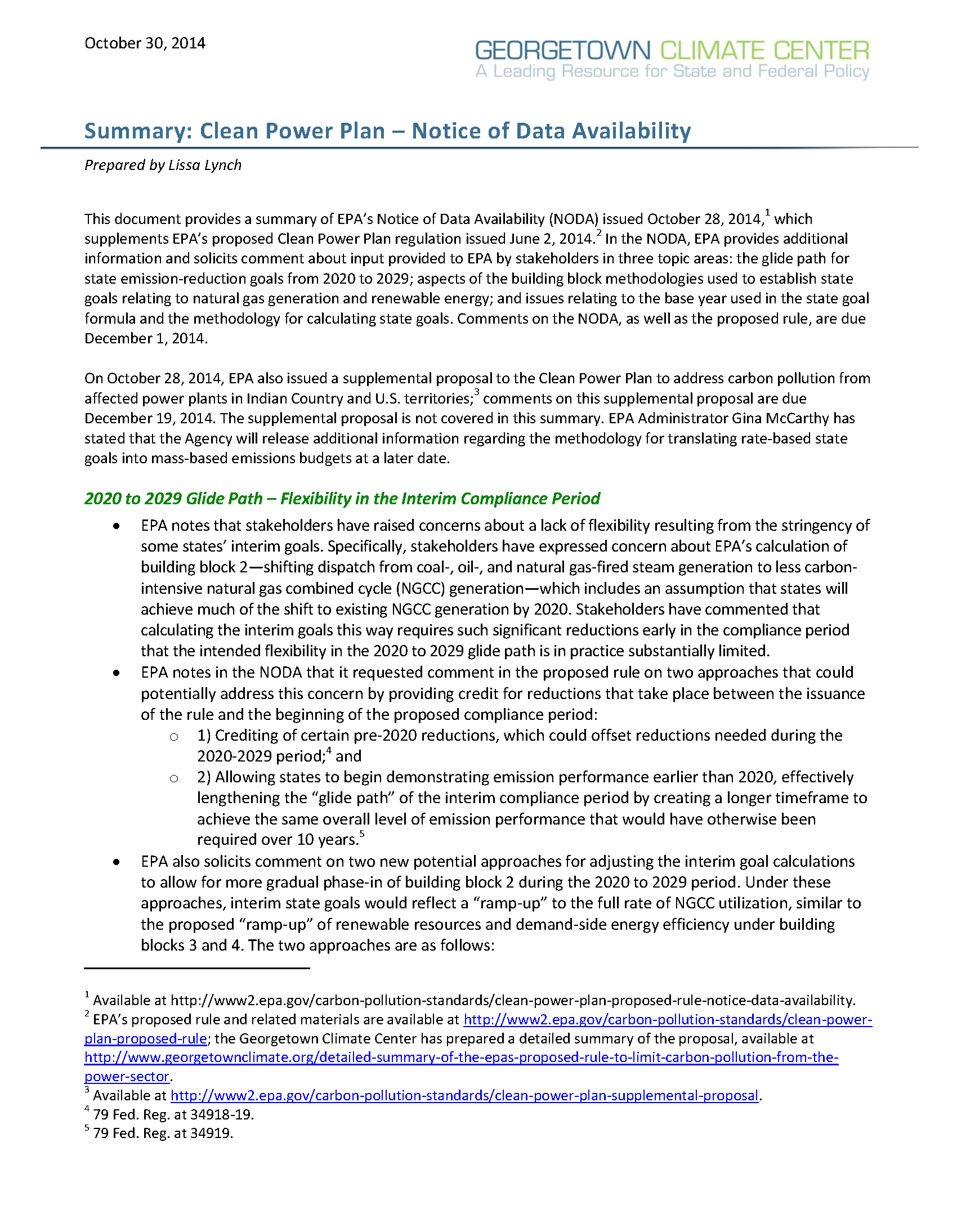
Summary of the EPA's Notice of Data Availability for the Clean Power Plan
November 6, 2014
This document provides a summary of EPA’s Notice of Data Availability issued October 28, 2014, which supplements EPA’s proposed Clean Power Plan regulation to limit carbon pollution from existing power plants.
Charging Ahead – Options for Policymakers Regarding the Regulation of Electric Vehicle Charging Markets
June 17, 2014
This paper provides an overview of the market for electric vehicle charging services, identifies actors and actions that might warrant regulation, and poses questions for policymakers to consider in determining the role that governments should play.
GCC Explainers | Understanding Recent Federal Actions & What They Mean for States
May 2, 2025
These explainers are part of GCC’s efforts to help state officials and stakeholders understand how recent federal actions may affect state policies and programs related to clean energy, climate change, and climate...
GCC welcomes Senior Associate Nate Burnand to Mitigation Program
April 11, 2025
Georgetown Climate Center is pleased to welcome Nate Burnand, who is joining the Mitigation Program as Senior Associate. Nate comes to GCC from the Michigan Public Service Commission, where he worked with partners...
GCC welcomes Senior Associate Amanda Lineberry to Mitigation Program
March 28, 2025
The Georgetown Climate Center is delighted to welcome Senior Associate Amanda Lineberry to our Mitigation Program. Amanda comes to GCC from the U.S. Department of Justice's Environmental and Natural Resources Division,...
GCC welcomes Melissa Birchard as Mitigation Program Director
August 28, 2024
The Georgetown Climate Center is delighted to welcome Melissa Birchard as the Mitigation Program Director. Melissa will lead GCC’s clean energy and climate change mitigation team, overseeing GCC’s work to support...
Issue Brief | Decarbonizing Healthcare: Clean Energy Projects under the Greenhouse Gas Reduction Fund
July 31, 2024
Overview With its recent announcement of grant awards to eight financial entities under the Greenhouse Gas Reduction Fund (GGRF), the Environmental Protection Agency (EPA) has set in motion an historic new initiative...
Decarbonizing Health Care: New Policies Can Build Markets for Low-Carbon Supply Chains
June 28, 2024
Health care delivery organizations (HDOs) like hospitals and clinics occupy a unique space in the fight against climate change – taking care of people exposed to the health risks of climate impacts, while taking steps...
Blog | Planning for Deep Decarbonization
June 13, 2024
Alice Kaswan is an Affiliated Scholar with the Georgetown Climate Center, from the University of San Francisco School of Law. This article was originally published by the Center for Progressive Reform, where Kaswan is...
Summary for Policymakers | Unlocking Equitable Access to Grants
May 9, 2024
Options for Federal Policymakers to Improve Matching Fund Requirements This is a Summary for Policymakers of a longer report released by GCC. Read the full report here. As federal policymakers award grant funds to...
Blog | Celebrating Climate Planning on Earth Day: A Look at Priority Climate Action Plans Across the U.S.
April 22, 2024
By Grace Gibson, GCC Climate Fellow As we recognize the 55th Earth Day this year, consider a notable milestone in the U.S.: climate planning is happening in all 50 states. While many states have over a decade of...
Report: Low-Carbon Transportation Policies Can Reduce Health Care Emissions and Benefit Local Communities
February 8, 2024
Hospitals, clinics, and other facilities that serve patients – also known as healthcare delivery organizations (or HDOs) – are pivotal players in the fight against climate change. They care for individuals impacted...