

In the United States, responding to the climate crisis depends on effective partnerships among federal, state, and local governments. When different levels of government collaborate and communicate with each other when they are developing climate and energy policies, they can go farther and faster in achieving durable, equitable, ambitious climate action for the health and welfare of the people across the country.
Much of the historic infusion of investment in resilience, clean energy, and low-carbon transportation infrastructure made possible via the 2021 Bipartisan Infrastructure Law (BIL or IIJA) and the 2022 Inflation Reduction Act (IRA) will require implementation at the state and local level.
The choices states and localities make when investing federal infrastructure dollars will meaningfully affect the success of federal and state policies and programs to address greenhouse gas emissions, improve community resilience, and address equity and environmental justice. Ensuring that federal funds are spent in ways that advance GHG emission reductions or climate resilience will require significant engagement by state and local policymakers to secure the necessary results and make sure benefits and costs are shared equitably.
Georgetown Climate Center’s work on infrastructure-related policy currently focuses on four interrelated opportunities:
- Helping state and federal policy makers understand the connections between their use of federal infrastructure funds and near- and long-term reductions in greenhouse gas emissions;
- Identifying opportunities to harness federal investment in infrastructure to improve resilience to the effects of climate change at the state, local and national levels;
- Supporting federal and state policymakers to achieve the equity and environmental justice goals of the Justice40 initiative as they make their infrastructure investment decisions; and
- Connecting policy makers with analysis and tools to accelerate the equitable deployment of charging infrastructure for electric vehicles.
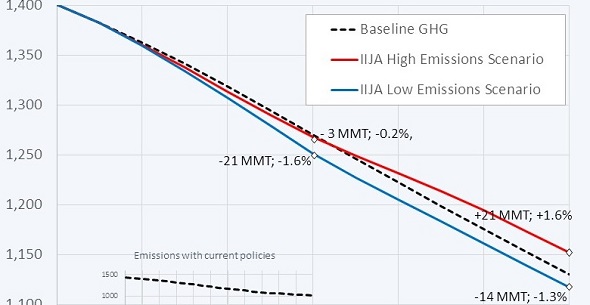
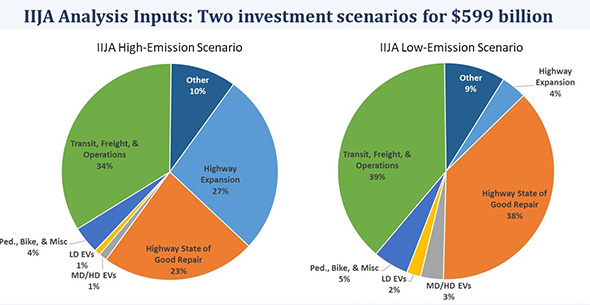
Issue Brief: Estimating the Greenhouse Gas Impact of Federal Infrastructure Investments in the IIJA
December 21, 2021
The bipartisan federal Infrastructure Investment and Jobs Act represents a historic investment in the underpinnings of our economy, especially when it comes to transportation. GCC is sharing this new analysis to help understand how these investments could help or hinder state and federal GHG reduction goals.
Memo: Opportunities for Climate-Related State Investments
December 20, 2021
This memorandum provides an overview of funding available to states in the Infrastructure Investments and Jobs Act, and potentially available in the Build Back Better Act, for climate-related investments along with key considerations for states that wish to take full advantage of this historic opportunity.
Low-Carbon Transportation Policy Options for the Commonwealth of Virginia
May 25, 2021
To inform ongoing conversations among stakeholders and government officials in the Commonwealth of Virginia, the Georgetown Climate Center commissioned analysis by Greenlink Analytics to model a variety of low-carbon transportation policy options. The modeling estimates potential benefits and costs from 2022 to 2040 that could result from these policies, including projected reductions in emissions of greenhouse gases and other air pollutants and effects on jobs, GDP, and public health.
GCC Comments to FHWA on revisions to the MUTCD
May 14, 2021
Towards Equitable and Transformative Investments in Electric Vehicle Charging Infrastructure
March 18, 2021
The electrification of cars, trucks, and buses is an important strategy for reducing greenhouse gas emissions and other air pollution, and can lead to cleaner air and healthier communities. As federal policymakers develop infrastructure and climate legislation to create jobs and spur economic recovery, the Georgetown Climate Center and M.J. Bradley & Associates have released Towards Equitable and Transformative Investments in Electric Vehicle Charging Infrastructure, to inform federal investments in electric vehicle (EV) charging infrastructure. Investments in EV charging present opportunities to advance equity and environmental justice, spur job creation, build the clean energy economy, and address the climate and public health crises facing the United States.
Written Statement of Vicki Arroyo before the U.S. Senate Committee on Environment and Public Works, July 2019
July 10, 2019
On Wednesday, July 10, 2019, GCC Executive Director Vicki Arroyo testified before the U.S. Senate Committee on Environment and Public Works on the role of transportation in contributing to climate change and the importance of increased investment in low-carbon, more resilient transportation systems to withstand climate change impacts.
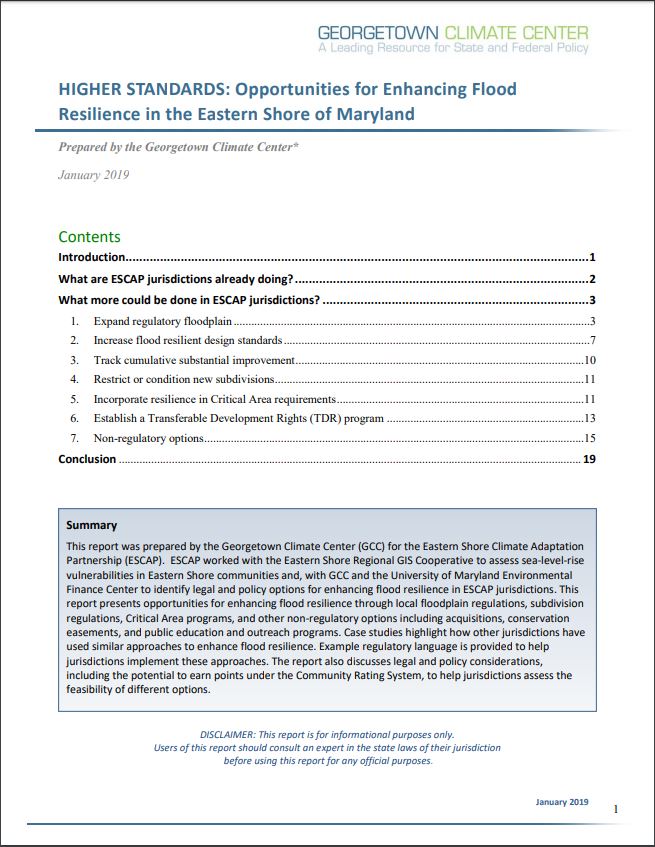
Higher Standards: Opportunities for Enhancing Flood Resilience in the Eastern Shore of Maryland
May 22, 2019
This report was prepared by the Georgetown Climate Center for the Eastern Shore Climate Adaptation Partnership (ESCAP) to inform efforts to prepare for impacts of sea-level rise in communities on the Eastern Shore of Maryland as part of the "Mainstreaming Sea Level Rise Preparedness in Local Planning and Policy on Maryland's Eastern Shore" initiative. This report presents opportunities for enhancing flood resilience in Eastern Shore communities through local floodplain regulations, subdivision regulations, and other non-regulatory options including acquisitions, conservation easements, and public education and outreach programs. Case studies highlight how other jurisdictions have used similar approaches to enhance flood resilience and model regulatory language is provided to help jurisdictions implement these approaches.
Written Statement of Vicki Arroyo before the U.S. House of Representatives Committee on Transportation and Infrastructure, February 26, 2019
February 28, 2019
On Tuesday, February 26, 2019, GCC Executive Director Vicki Arroyo testified before the full House Committee on Transportation and Infrastructure at a hearing entitled "Examining How Federal Infrastructure Policy Could Help Mitigate and Adapt to Climate Change." Arroyo provided spoken and written testimony to the Committee, and fielded questions along with the other panelists.
Regulatory Considerations for Utility Investment in EV Charging Infrastructure
November 13, 2017
A report released from the Georgetown Climate Center and M.J. Bradley & Associates provides an overview of the accelerating electrification of the transportation sector and explores the role of state utility regulators in evaluating potential investments by electric utilities in EV charging infrastructure. The report identifies key considerations for regulators, including the amount of charging infrastructure needed to support EVs, ways that regulators can help ensure equitable access to charging infrastructure, and opportunities to maximize the benefits of utility investment in charging infrastructure.
Issue Brief | Building Local Governance Structures for Evaluating Data Center Proposals
September 3, 2026
Five steps local governments can take to prepare for decisions about data centers Local governments across the country are responding to the prospect of data center development, as well as growing public concerns about...
Issue Brief | What to Make of Data Center Moratoriums?
August 12, 2026
A framework for identifying three different types of data center moratoriums at the local and state levels. State and local governments have been proposing – and in many cases enacting – moratoriums on data center...
GCC Resources on Data Centers & Large Electric Load Growth
August 12, 2026
*NEW* Issue Brief | Building Local Governance Structures for Evaluating Data Center Proposals (September 3, 2026) Issue Brief | What to Make of Data Center Moratoriums? (August 12, 2026) Issue Brief | State...
Issue Brief | More Roads but Fewer Options
July 9, 2026
To better understand how the proposed Reauthorization bill could affect real-world outcomes, the Georgetown Climate Center estimated how BA250 could affect climate pollution, electric vehicle (EV) deployment, traffic safety and household costs for U.S. residents. Results are published in a new GCC Issue Brief: More Roads but Fewer Options.
This explainer is part of GCC’s efforts to help state officials and stakeholders understand how recent federal actions may affect state policies and programs related to clean energy, climate change, and climate...
Issue Brief | State Utility Tariffs: A Tool to Manage Large Load Growth
March 20, 2026
Demand for electricity is rising rapidly due to the growth of data centers and other new large electric customers, as GCC recently highlighted in an introductory blog on large loads. In a new issue brief released today,...
Adaptation Policy in Practice | The Strengthen Alabama Homes Program: A State Model for Wind Mitigation Retrofits
February 19, 2026
Second Installment in GCC’s Adaptation Policy in Practice Series In Alabama, like in many coastal states, tens of thousands of homes are susceptible to damage from increasingly severe hurricanes and tornadoes, yet the...
Statement on the US EPA's Reversal of the Endangerment Finding for Greenhouse Gases
February 12, 2026
“EPA’s reversal of the Endangerment Finding undermines decades of progress to address the existential threat of climate change,” said Kate Zyla, Georgetown Climate Center’s Executive Director. “The Agency’s...
Issue Brief | Aligning Transportation Planning with State Climate Goals
February 5, 2026
Opportunities for State Departments of Transportation Read the full issue brief (PDF) As the agencies that oversee the planning, funding, and maintenance of most of the nation’s transportation systems, state...
Adaptation Policy in Practice | How New Jersey is Breaking the Cycles of Repetitive Flood Loss
December 11, 2025
First Installment in GCC's Adaptation Policy in Practice Series People living in flood-prone homes face a problem that property insurance and emergency response cannot solve. When homes flood repeatedly, the damage...