

In the United States, responding to the climate crisis depends on effective partnerships among federal, state, and local governments. When different levels of government collaborate and communicate with each other when they are developing climate and energy policies, they can go farther and faster in achieving durable, equitable, ambitious climate action for the health and welfare of the people across the country.
Much of the historic infusion of investment in resilience, clean energy, and low-carbon transportation infrastructure made possible via the 2021 Bipartisan Infrastructure Law (BIL or IIJA) and the 2022 Inflation Reduction Act (IRA) will require implementation at the state and local level.
The choices states and localities make when investing federal infrastructure dollars will meaningfully affect the success of federal and state policies and programs to address greenhouse gas emissions, improve community resilience, and address equity and environmental justice. Ensuring that federal funds are spent in ways that advance GHG emission reductions or climate resilience will require significant engagement by state and local policymakers to secure the necessary results and make sure benefits and costs are shared equitably.
Georgetown Climate Center’s work on infrastructure-related policy currently focuses on four interrelated opportunities:
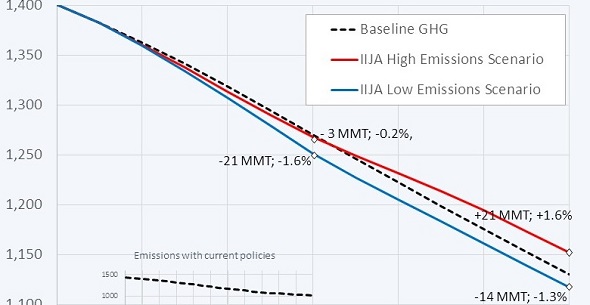
- Helping state and federal policy makers understand the connections between their use of federal infrastructure funds and near- and long-term reductions in greenhouse gas emissions;
- Identifying opportunities to harness federal investment in infrastructure to improve resilience to the effects of climate change at the state, local and national levels;
- Supporting federal and state policymakers to achieve the equity and environmental justice goals of the Justice40 initiative as they make their infrastructure investment decisions; and
- Connecting policy makers with analysis and tools to accelerate the equitable deployment of charging infrastructure for electric vehicles.
Issue Brief | Planning for Equitable EV Charging: A Review of Justice40 Elements in National EV Infrastructure State Plans
August 28, 2024
By Sherif Halaweish, Climate Fellow and Matthew Goetz, Associate Mitigation Director As states across the country prepare to implement a new round of funding for EV charging infrastructure by updating their National...
Blog | New State Transportation & Climate Planning Requirements Offer Models for GHG-conscious Investment
August 6, 2024
A trio of states build upon an emerging body of policies to align transportation investments with climate action planning, demonstrating opportunities for others to follow. In recent months, three states — Hawaii,...
Issue Brief | Decarbonizing Healthcare: Clean Energy Projects under the Greenhouse Gas Reduction Fund
July 31, 2024
Overview With its recent announcement of grant awards to eight financial entities under the Greenhouse Gas Reduction Fund (GGRF), the Environmental Protection Agency (EPA) has set in motion an historic new initiative...
National Electric Vehicle Infrastructure Program Equity Dashboard
July 22, 2024
The National Electric Vehicle Infrastructure Program Equity Dashboard summarizes elements related to the Justice40 Initiative (Justice40 or J40) in the National Electric Vehicle Infrastructure (NEVI) Program plans...
Summary for Policymakers | Unlocking Equitable Access to Grants
May 9, 2024
Options for Federal Policymakers to Improve Matching Fund Requirements This is a Summary for Policymakers of a longer report released by GCC. Read the full report here. As federal policymakers award grant funds to...
As federal policymakers award grant funds to implement climate, clean energy, transportation, and other programs, they have opportunities to remove barriers to the equitable distribution of federal resources. Non-federal...
Blog | Celebrating Climate Planning on Earth Day: A Look at Priority Climate Action Plans Across the U.S.
April 22, 2024
By Grace Gibson, GCC Climate Fellow As we recognize the 55th Earth Day this year, consider a notable milestone in the U.S.: climate planning is happening in all 50 states. While many states have over a decade of...
Blog | Resilience in Action: Insights from the 2024 Southwest Adaptation Forum
March 28, 2024
GCC Institite Associate Shapes Padilla (center) listens in as Dr. Karletta Chief, Director of the Indigenous Resilience Center at the University of Arizona, welcomes participants of the 2024 Southwest...
Report: Low-Carbon Transportation Policies Can Reduce Health Care Emissions and Benefit Local Communities
February 8, 2024
Hospitals, clinics, and other facilities that serve patients – also known as healthcare delivery organizations (or HDOs) – are pivotal players in the fight against climate change. They care for individuals impacted...
BLOG | Signs of Progress: US DOT enables EV charging station logo signs along highways
February 2, 2024
Recent action by the federal government to allow businesses with electric vehicle (EV) charging stations to appear on highway logo signs is a chance to create a better driving experience for EV drivers. It could also help boost the EV transition and ease range anxiety by increasing visibility of EV charging stations, but realizing these benefits will require action by state DOTs.