



In the United States, responding to the climate crisis depends on effective partnerships among federal, state, and local governments. When different levels of government collaborate and communicate with each other when they are developing climate and energy policies, they can go farther and faster in achieving durable, equitable, ambitious climate action for the health and welfare of the people across the country.
Much of the historic infusion of investment in resilience, clean energy, and low-carbon transportation infrastructure made possible via the 2021 Bipartisan Infrastructure Law (BIL or IIJA) and the 2022 Inflation Reduction Act (IRA) will require implementation at the state and local level.
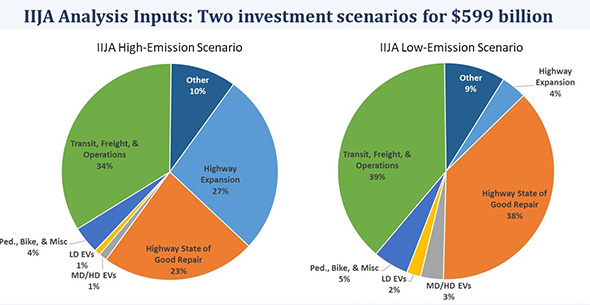
The choices states and localities make when investing federal infrastructure dollars will meaningfully affect the success of federal and state policies and programs to address greenhouse gas emissions, improve community resilience, and address equity and environmental justice. Ensuring that federal funds are spent in ways that advance GHG emission reductions or climate resilience will require significant engagement by state and local policymakers to secure the necessary results and make sure benefits and costs are shared equitably.
Georgetown Climate Center’s work on infrastructure-related policy currently focuses on four interrelated opportunities:
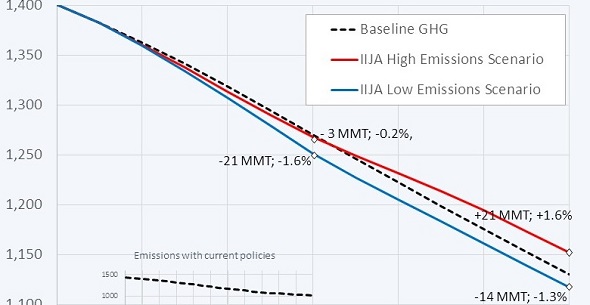
- Helping state and federal policy makers understand the connections between their use of federal infrastructure funds and near- and long-term reductions in greenhouse gas emissions;
- Identifying opportunities to harness federal investment in infrastructure to improve resilience to the effects of climate change at the state, local and national levels;
- Supporting federal and state policymakers to achieve the equity and environmental justice goals of the Justice40 initiative as they make their infrastructure investment decisions; and
- Connecting policy makers with analysis and tools to accelerate the equitable deployment of charging infrastructure for electric vehicles.
Issue Brief | States have flexibility to invest federal highway funds in climate-smart transportation
February 21, 2023
The U.S. has seen a historic influx of federal funding for improving America's transportation systems, especially through the $1.2 billion Bipartisan Infrastructure Law (BIL). In a new issue brief, “Flexible Federal...
Webinar Recording: “Advancing New Jersey's Climate Goals with Transportation Infrastructure Investments”
January 26, 2023
On January 20, GCC’s Director of Mitigation Programs James Bradbury was the featured speaker for a virtual Climate Academy presented by the NJ Climate Change Research Center at Rutgers University. Over the next 5...
One Year Later: GCC reflects on the passage of the Bipartisan Infrastructure Law
November 15, 2022
This article was originally posted as a Twitter thread @Climate_Center. Today marks one year since President Biden signed the Bipartisan Infrastructure Law (BIL), also known as the Infrastructure Investment and Jobs Act...
COP27: GCC to host side event on subnational leadership with The Climate Registry and US Green Building Council
November 9, 2022
Event: Achieving measurable climate benefits through innovative infrastructure investments in North America Date: 10 November, 2022 Time: 11:30 AM to 1 PM Local Time (4:30 - 6 AM Eastern U.S. Time) Location:...
Transportation Agencies from 10 States and D.C. Voice Support for Federal Proposal to Track Greenhouse Gas Emissions from National Highways
October 13, 2022
States Across the Country Say Proposed Performance Measure Can Help Reduce Pollution, Improve Resilience of National Highway System October 13, 2022 — In joint comments submitted to the U.S. Department of...
Driving Resilience: How the bipartisan Infrastructure Investment and Jobs Act can support widespread climate resilience
August 11, 2022
Resilience is integrated throughout sections of the bipartisan Infrastructure Investment and Jobs Act (IIJA) (H.R. 3684, also known as the Bipartisan Infrastructure Law) and includes programs that can help alleviate the...
Statement from the Georgetown Climate Center on FHWA's Proposed GHG Performance Measure
July 7, 2022
This morning, the Federal Highway Administration (FHWA), a division of the U.S. Department of Transportation, released a proposed rule to guide states and metropolitan planning organizations (MPOs) in measuring and...
8 Ways US States and Cities Can Create a National EV Charging Network
June 23, 2022
By: Devashree Saha (Word Resources Institute), Matthew Goetz (GCC), Dan Lashof (World Resources Institute), Franz Litz (Litz Strategies) Electric vehicles (EVs) are on the rise in the United States. The Biden...
Evaluation and Development of Regional Infrastructure for Vehicle Electrification (E-DRIVE)
October 15, 2021
The Evaluation and Development of Regional Infrastructure for Vehicle Electrification (E-DRIVE) is a user-friendly analytical tool that supports the planning of electric vehicle (EV) fast charging infrastructure...
Regional EV Charging Infrastructure Location Identification Toolkit (ILIT)
August 17, 2021
The Regional EV Charging Infrastructure Location Identification Toolkit for the Northeast, Mid-Atlantic, and Southeast states provides resources to support state and local government planning for more equitable and informed investments in electric vehicle (EV) charging infrastructure.